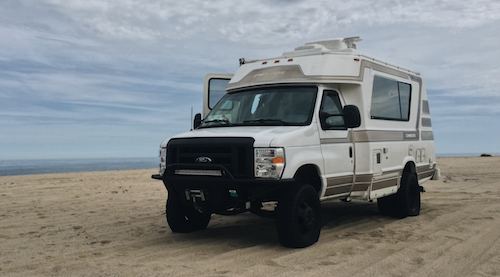
I removed the regular awning, and want to reinforce it with riv-nut attachment. Do I need to add any backing to the back of the fiberglass, or I can simply drill the screw holes larger to fit the rivnuts, and then install them? One potential issue I have with riv-nut is that if the awning is not installed back, there will be a dozen holes that I probably will need to be plug with bolts.
Edit:
It is probably easier to reinforce the rear awning since the headliner can be easily removed (I think... never did it).
Rear Awning, anyone done it?
Re: Rear Awning, anyone done it?
2000 Concourse dinette, on 1999 6.8L Ford E350 Triton V-10 Chassis
-
HoosierB

- **Forum Contributor**
- Posts: 473
- Joined: May 21st, 2015, 7:00 pm
- Location: South Bend, Indiana
Re: Rear Awning, anyone done it?
Blue~Go wrote:
"BTW on an awning with only the one attachment (roof case), I would want a much more substantial backing at the attachments than with the more typical one with "four point" suspension (roof case at both ends plus legs on ground or body)."
Blue, I came to the same conclusion back when doing research for a retractable Over-the-Door (box) awning.
Most store-bought versions don't offer much canopy coverage for the money and would still need some modification to work properly on the Chinook, i.e. clearance for door height, ladder, attachment, etc.. Just offering up ideas for the OP.
BTW: I had fabricated a "canopy set-up" using telescoping poles and a tarp with eyelets, etc. like you described, only to find out it didn't fit our travel style (touring and overnights). The less "stuff" to unpack/set-up/pack, the better.
However, even on our one-nights we do put out chairs
"BTW on an awning with only the one attachment (roof case), I would want a much more substantial backing at the attachments than with the more typical one with "four point" suspension (roof case at both ends plus legs on ground or body)."
Blue, I came to the same conclusion back when doing research for a retractable Over-the-Door (box) awning.
Most store-bought versions don't offer much canopy coverage for the money and would still need some modification to work properly on the Chinook, i.e. clearance for door height, ladder, attachment, etc.. Just offering up ideas for the OP.
BTW: I had fabricated a "canopy set-up" using telescoping poles and a tarp with eyelets, etc. like you described, only to find out it didn't fit our travel style (touring and overnights). The less "stuff" to unpack/set-up/pack, the better.
However, even on our one-nights we do put out chairs
"Wanda" – '01 Chinook Concourse XL V10

Re: Rear Awning, anyone done it?
Could you explain a little bit more what your goals are? I've used Riv-nuts for a few things, but I don't see how they (in and of themselves) will strengthen anything. But maybe you have other reasons (such as you want to be able to remove and replace the entire awning on a regular basis). So can you say what you are looking to do?chin_k wrote: February 6th, 2019, 1:05 pm I removed the regular awning, and want to reinforce it with riv-nut attachment. Do I need to add any backing to the back of the fiberglass, or I can simply drill the screw holes larger to fit the rivnuts, and then install them?
1999 Concourse
Re: Rear Awning, anyone done it?
That sounds nifty. Also reminds me that the Shady Boy might be an option for some people (with some modification).HoosierB wrote: February 7th, 2019, 8:36 am BTW: I had fabricated a "canopy set-up" using telescoping poles and a tarp with eyelets, etc.
Chairs? Geez, might as well homesteadHoosierB wrote: February 7th, 2019, 8:36 amonly to find out it didn't fit our travel style (touring and overnights). The less "stuff" to unpack/set-up/pack, the better.
However, even on our one-nights we do put out chairs
1999 Concourse
Re: Rear Awning, anyone done it?
Blue, yes, one of my goals is to remove the awning for trips that does not need it. It is bad for the fiberglass if I do that a few times due to the screw holes, but with rivnut, I think it should be more robust for reinstall/remove several times a year. When I go camp in the wood, we never use the awning, but once a while, we do go to the desert with no cover, and we do want to use it. I do know the camping ahead of time, so I can prep to put it back on when needed. I think we only use it average maybe twice a year on those trips, while vast majority of the time we don't need it.
Maybe if the hassle of removing/reinstall will get to be a hassle after I do the reinforcement, but I can always keep it on there when the time comes.
Maybe if the hassle of removing/reinstall will get to be a hassle after I do the reinforcement, but I can always keep it on there when the time comes.
2000 Concourse dinette, on 1999 6.8L Ford E350 Triton V-10 Chassis
-
eporter123
- **Forum Contributor**
- Posts: 184
- Joined: April 2nd, 2018, 9:50 am
Re: Rear Awning, anyone done it?
Riv-nuts would make more sense with several metal backing plates to spread out the load. I'm not sure how they'd work with fiberglass. Then you could just have one or two secure bolting spots per awning mount location, and seal up the factory Chinook screw holes.
Have you heard of plus-nuts? They spread out a bunch on their own. One of those with a large fender washer might be perfect with the fiberglass.
https://www.pointsunknown.com/blog/2016 ... -plusnuts/
Have you heard of plus-nuts? They spread out a bunch on their own. One of those with a large fender washer might be perfect with the fiberglass.
https://www.pointsunknown.com/blog/2016 ... -plusnuts/
Former owner of a 2000 Chinook Premier, V-10, with no Interior...
Re: Rear Awning, anyone done it?
The plusnut seems to be better for non-sheet metal application like our rig. I will definitely look more into this. For aviation, however, I think the rivnut looks cleaner, but I guess no one look inside. It may not make much difference if an appropriate backing plate is used, however.
So I can just remove the overhead to get to the inside to add the backing plate? Never take the overhead out, but I think some people here warned me that it is very heavy.
So I can just remove the overhead to get to the inside to add the backing plate? Never take the overhead out, but I think some people here warned me that it is very heavy.
2000 Concourse dinette, on 1999 6.8L Ford E350 Triton V-10 Chassis
-
HoosierB
- **Forum Contributor**
- Posts: 473
- Joined: May 21st, 2015, 7:00 pm
- Location: South Bend, Indiana
Re: Rear Awning, anyone done it?
Ha! That was the inspiration for my mod attempt! The Shady Boy is not a bad set-up for about $400. It's light-weight, well made and provides a fairly large canopy.Blue~Go wrote: February 7th, 2019, 9:24 am That sounds nifty. Also reminds me that the Shady Boy might be an option for some people (with some modification).
"Wanda" – '01 Chinook Concourse XL V10
Re: Rear Awning, anyone done it?
Okay, so there are two different factors at play:
1) You want to be able to remove and replace the awning multiple times, without degradation of the fastening system. Since you are talking about the fiberglass shell, it sounds like you are also talking about removing the brackets, not just the awning from the brackets. That makes it more complicated as the brackets are bedded to the shell (or should be!) to keep water out.
2) You want (and I agree with) to reinforce the attachment of the brackets to the shell (which is nothing to write home about as built, although it seems to hang on).
For #1, I would want some sort of repeatable fastener such as a machine screw. Since you don't want to have to hold onto the back side each time, something like a riv nut or a plus nut seems to make sense. But then would you be having to unbed and re-bed each time? That sounds like a bit much. Maybe you could use well nuts that have a rubber insert? (See more below.)
For #2, I would want a healthy backing plate. Perhaps a flat piece of FRP board (fiberglass - can be bought at McMaster Carr) bonded in place with thickened epoxy. This would reinforce the shell, plus make it flat on the backside (the thickened epoxy would adjust for the irregularities). You could also use metal or even wood, but FRP board is nice and flat and expands/contracts exactly the same and is water proof. So why not. But whatever, you are just trying to spread the load. On my awning one of the plates is in the closet, and the other is behind the upper cabinets more forward (you can obviously see these on the outside at the bottom edge of the awning).
The other thing to consider is how you are going to handle the small screws that drive upward from the bottom leg of the awning bracket into the awning case. If you haven't removed it yet, the awning kind of tilts and then clicks into the L shaped legs (which are mounted to the shell), then you drive screws up through the bottom leg of the bracket into the awning case to keep the awning from coming off the brackets. Perhaps rivnuts again?
Speaking of which, you could just remove the awning from the brackets and leave the brackets on the Chinook body. That would be much simpler. I'd still prefer to improve the attachment of the brackets to the shell, but you could do it with simple machine screws, backing plates, nuts and washers (plus "permanent" bedding) if not planning to the brackets each time.
BTW, I base this on helping a friend remove and replace a Fiamma awning that is just like ours but longer, after he tore it off on a tree and then ordered a new one. From what I can see our Fiammas mount just the same. I have also seen the backside of the pointy screws on ours inside the shell when doing remodeling work.
I almost never use my awning. If I changed anything it would be to replace it with a window awning. However that said, I have never found the rolled up awning to be an issue when driving, even back in the woods. The rest of the body sticks out far enough that I consider a road too narrow before the awning comes into play (not saying you couldn't catch it on a tree, like my friend did, but that was in an established campground and he is a bad driver and tends to tear awnings off). I doubt it changes gas mileage much due to the fact of how big our "barn" is that we're trying to push down the road. OTOH, sometimes you just want to do something - that certainly applies to me with other things. So you think outside the box
1) You want to be able to remove and replace the awning multiple times, without degradation of the fastening system. Since you are talking about the fiberglass shell, it sounds like you are also talking about removing the brackets, not just the awning from the brackets. That makes it more complicated as the brackets are bedded to the shell (or should be!) to keep water out.
2) You want (and I agree with) to reinforce the attachment of the brackets to the shell (which is nothing to write home about as built, although it seems to hang on).
For #1, I would want some sort of repeatable fastener such as a machine screw. Since you don't want to have to hold onto the back side each time, something like a riv nut or a plus nut seems to make sense. But then would you be having to unbed and re-bed each time? That sounds like a bit much. Maybe you could use well nuts that have a rubber insert? (See more below.)
For #2, I would want a healthy backing plate. Perhaps a flat piece of FRP board (fiberglass - can be bought at McMaster Carr) bonded in place with thickened epoxy. This would reinforce the shell, plus make it flat on the backside (the thickened epoxy would adjust for the irregularities). You could also use metal or even wood, but FRP board is nice and flat and expands/contracts exactly the same and is water proof. So why not. But whatever, you are just trying to spread the load. On my awning one of the plates is in the closet, and the other is behind the upper cabinets more forward (you can obviously see these on the outside at the bottom edge of the awning).
The other thing to consider is how you are going to handle the small screws that drive upward from the bottom leg of the awning bracket into the awning case. If you haven't removed it yet, the awning kind of tilts and then clicks into the L shaped legs (which are mounted to the shell), then you drive screws up through the bottom leg of the bracket into the awning case to keep the awning from coming off the brackets. Perhaps rivnuts again?
Speaking of which, you could just remove the awning from the brackets and leave the brackets on the Chinook body. That would be much simpler. I'd still prefer to improve the attachment of the brackets to the shell, but you could do it with simple machine screws, backing plates, nuts and washers (plus "permanent" bedding) if not planning to the brackets each time.
BTW, I base this on helping a friend remove and replace a Fiamma awning that is just like ours but longer, after he tore it off on a tree and then ordered a new one. From what I can see our Fiammas mount just the same. I have also seen the backside of the pointy screws on ours inside the shell when doing remodeling work.
I almost never use my awning. If I changed anything it would be to replace it with a window awning. However that said, I have never found the rolled up awning to be an issue when driving, even back in the woods. The rest of the body sticks out far enough that I consider a road too narrow before the awning comes into play (not saying you couldn't catch it on a tree, like my friend did, but that was in an established campground and he is a bad driver and tends to tear awnings off). I doubt it changes gas mileage much due to the fact of how big our "barn" is that we're trying to push down the road. OTOH, sometimes you just want to do something - that certainly applies to me with other things. So you think outside the box
1999 Concourse
Re: Rear Awning, anyone done it?
I missed the part where you were asking about getting to the backside. Placement may vary slightly, but on mine the rear one is outboard of the closet, close to (or slightly overlapping) the refrigerator divider wall. The closet may cover it (I forget).
The other one is either behind the overhead cabinets forward or possibly just behind the wall forward of the cabinets (look at your specific ones).
If behind the cabinets, you may be able to just remove the carpeted liner boards. I have some annotated photos showing this somewhere in a previous post. If behind the wall forward of the cabinets, then you could possibly make a mod where you create a "hinge in that little section of wallboard, or something custom like that.
You *can* remove the upper cabinets, but I'm not sure you'd need to. If you do, you'd have to remove the carpeted liner boards anyway to disconnect some wires; then it's just screws into the wall and overhead around the perimeter. Yes, they are heavy! But a lot of weight is the doors. At least the dinette side is shorter.
The other one is either behind the overhead cabinets forward or possibly just behind the wall forward of the cabinets (look at your specific ones).
If behind the cabinets, you may be able to just remove the carpeted liner boards. I have some annotated photos showing this somewhere in a previous post. If behind the wall forward of the cabinets, then you could possibly make a mod where you create a "hinge in that little section of wallboard, or something custom like that.
You *can* remove the upper cabinets, but I'm not sure you'd need to. If you do, you'd have to remove the carpeted liner boards anyway to disconnect some wires; then it's just screws into the wall and overhead around the perimeter. Yes, they are heavy! But a lot of weight is the doors. At least the dinette side is shorter.
1999 Concourse