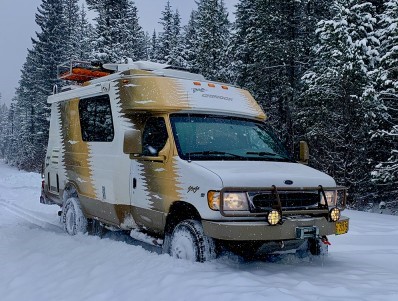
Chinook owners that have much experience on the topic of boondocking with a Chinook please share your experiences and knowledge. Hints and tips? Like where you do it and some guide lines as to picking spots. I realize there are GPS map files, RV website threads, and such which this information but Chinook experiences would be good plus having such info on this forum would be good too.
I've done it in a few places like truck stops or visiting friends but am always looking for input. My wife and I are pretty good at conserving water, power, and sewer but any more info on how to handle those things (ie: where to dump) is always good to know. When off grid we still take showers daily (rinse, soap, rinse), wash a few dishes, and do what's needed on the sewer side of things. Lighting can be limited and after a day of travelling we don't stay up very late unlike when at home. In the morning we'll fire up the generator to perk a pot of coffee and do some charging while it's running then shut off (~15 mins). I find that two people will use the fresh water and fill the grey water tank in 2+ days this way in a Chinook. The 32 gallon fresh water and 35 gallon gray water tanks are very big for a small RV so that's another Chinook perk.
Boondocking
Boondocking
2004 Chinook Concourse (Sold and missed)
Re: Boondocking
Here's a site I'm seriously considering joining. It's people who rv (90% of them) who open up their yards/farms for free. And most will even let you hook up. So many across the country and it's $25 a year. You can check out the map of where everyone is located. It's generalized for the non-paying folks. https://www.boondockerswelcome.com/ Harvest Hosts is another one where you can stay on winery properties.
'02 Concourse where there's always a project going on...

Re: Boondocking
I boondock about 90% of the time, so I should be able to contribute something, but.... it's a big topic! Maybe I can chip away at it a little though. Definitely worth talking about.
1999 Concourse
Re: Boondocking
As you pointed out, there are quite a few web resources for places to boondock. Still, like you say, it's fun to share some tips and ideas.Concourse wrote:Chinook owners that have much experience on the topic of boondocking with a Chinook please share your experiences and knowledge.
I've done it in a few places like truck stops or visiting friends but am always looking for input.
One note is that I mentally have two different categories for this type of thing. Stays at pavement places that are typically for one night enroute (Wal-Mart, rest area, truck stop, etc.) I think of more as overnight parking. Whereas for me, boondocking is camping out in "the wild" (i.e. not in any sort of established campground). Typically boondocking is for more than one night, but that varies. Most US boondocking locales have a 14-day stay limit, so if my setup can go 14 days, I'm content.
As a third category, I have "dry camping" which is camping in a campground type setup, but with no utilities (National Forest Campground or etc.). With dry camping you sometimes have access to garbage disposal, maybe water at a central spigot, possibly an outhouse type toilet, etc. But even if so, they are not at your site. Some dry camping spots have none of these, and are just a "spot," so not a whole lot different than boondocking, although the sites are official and you typically do pay a small amount.
Aside from just keeping an eye out and knowing some likely locations (gas stations, some rest areas), I use either sanidumps.com or rvdumps.com. Oftentimes if a gas station has a dump, they will offer it for free or a reduced cost if you fuel there. Another thing is that you can often pull into a campground and they will let you dump for a fee (but less cost than camping overnight there).Concourse wrote: ... info on how to handle those things (ie: where to dump) is always good to know.
I find there are a few inter-related things here. One is that most (all?) production RV's are initially set up for driving campground-to-campground, and then plugging into shore power upon arrival. So for "serious" boondocking, they need to be re-configured if you want to do anything beyond a night or two, or pretty stringent "hard wall camping." Mostly this is in the area of electrical power (getting/storing/using). I'm not a fan of the generator (noise both for me and anyone within a pretty long range), and many boondocking spots discourage or disallow them. At any rate, at least for me, longer-term boondocking needs to involve some solar power gathering, plus a good way to store that power (battery bank), wiring and components that eliminate too much fire danger and/or battery damage, and then efficient appliances (LED lighting, 12-volt vs. 110/inverter, etc.). Of course these things are not necessary for one or two night stints.Concourse wrote:My wife and I are pretty good at conserving water, power, and sewer but any more When off grid we still take showers daily (rinse, soap, rinse), wash a few dishes, and do what's needed on the sewer side of things. Lighting can be limited and after a day of travelling we don't stay up very late unlike when at home. In the morning we'll fire up the generator to perk a pot of coffee and do some charging while it's running then shut off (~15 mins). I find that two people will use the fresh water and fill the grey water tank in 2+ days this way in a Chinook. The 32 gallon fresh water and 35 gallon gray water tanks are very big for a small RV so that's another Chinook perk.
On the tankage, just for interest, on my '99 Concourse:
Gas (fuel) tank: Published spec 37 gallons; actual 37 gallons (as per Ford and also measured via fill up after entering gas station "on fumes").
Propane tank: Spec 19 gallons; actual 18.8 gallons (capacity stamped into tank). That said, propane tanks can only be filled 80% full so it is around 15 gallons real-world capacity.
Fresh water tank: Spec 36 gallons; actual ~29-30 gallons (by measuring outside of tank and running through calculator, then subtracting for wall thickness and notch out of one corner - I could not find the capacity stamped into the tank - even after removing it and looking it over closely). I may measure it again just to double check, so take this as an estimate for now.
Water heater: Spec 6 gallons; actual 6 gallons (as rated by Suburban). Of course since this always refills it is 6 gallons of hot water, but does not add 6 gallons to usable fresh-water capacity (as I see on many RV brochures... ahem).
Grey water tank: Spec 36 gallons; actual 36 gallons (capacity stamped into side of tank by Inca, tank mfgr.). I have not tested usable capacity, but as I recall, my vent tube does not extend to far into tank, so likely it is as stated.
Black water tank: Spec 15 gallons; actual 15 gallons (capacity stamped into side of tank). Usable on mine is around 13 gallons, I believe due to slight (1" or so) protrusion of vent pipe into tank. I have seen where other Chinooks were even "worse." Since both grey and black are wide/shallow tanks, even a slight projection of vent pipe into tank takes away quite a bit of capacity. I'm going to pull mine out and trim it at some point. Will be interesting to see if I gain the whole two gallons back or if maybe Inca rates capacity by outside dimensions of their tanks (?), which could also affect grey tank (also made by Inca on my rig).
More later, have to run for now.
1999 Concourse
Re: Boondocking
I'd be interested in seeing pictures if you pull it again. And if you feel like taking pictures during the process. I'd love to rip mine apart just to get at all the carpet under the couch but I'm afraid I won't get it back together correctly! I'd love to pull it all up, take out the carpet, put down flooring, and put it all back.
'02 Concourse where there's always a project going on...