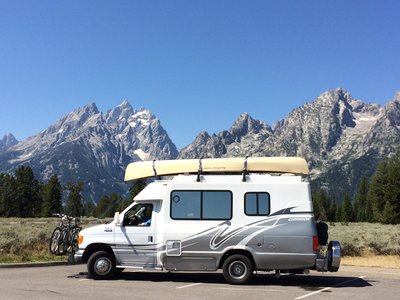
How does the interior of the Chinook Concourse hold up while driving off road, if on bumpy/gravel forest service roads does the interior suffer any problems or are the interior builds sturdy enough to handle this type of driving? Any difference if you have 4x4 Chinook?
I assume cabinets can open but is there risk of structural issues like cabinets seperating from walls or each other, plumbing holding up, etc.....
Thanks in advance.
How does interior hold up on bumpy dirt roads
How does interior hold up on bumpy dirt roads
2001 Concourse XL Lounge model, 6.8L Ford E350 Triton V-10 Chassis.

Re: How does interior hold up on bumpy dirt roads
I don't think there is any difference in the cabinetry structure in the 4x4 models. At least in the photos of Bajas I have seen.
I go down gravel roads, and some bumpy roads, albeit slowly. No problems so far (4-1/2 years).
Two Chinooks I can remember reading about having the long upper cabinets come down. I don't know that either of those were on specifically dirt roads (probably I-10 in the south ). I'm not surprised as the cabinets are HEAVY, and they are mostly held on by screws only in tension (overhead), with a little bit of shear (walls). (I have taken mine out for remodeling is how I know - mine never detached on their own.) If I remember correctly mine were close to 100# each
A few Chinooks I've seen with small cracks in the outer shell, but no idea if that was from any specific road or just a bit of tension built in that later showed itself (it can happen: hard spot, awkward-to-build-corner, etc.).
I have had a trailer, campervan, and now my Chinook. Personally, I just can't stand to barrel down bumpy backroads with my "house," no matter if it's sturdy or not (and of course the van was a factory metal body, but still) So I take it easy. But that's just me. It may not be completely necessary.
Interested to hear what others think.
I go down gravel roads, and some bumpy roads, albeit slowly. No problems so far (4-1/2 years).
Two Chinooks I can remember reading about having the long upper cabinets come down. I don't know that either of those were on specifically dirt roads (probably I-10 in the south
). I'm not surprised as the cabinets are HEAVY, and they are mostly held on by screws only in tension (overhead), with a little bit of shear (walls). (I have taken mine out for remodeling is how I know - mine never detached on their own.) If I remember correctly mine were close to 100# each A few Chinooks I've seen with small cracks in the outer shell, but no idea if that was from any specific road or just a bit of tension built in that later showed itself (it can happen: hard spot, awkward-to-build-corner, etc.).
I have had a trailer, campervan, and now my Chinook. Personally, I just can't stand to barrel down bumpy backroads with my "house," no matter if it's sturdy or not (and of course the van was a factory metal body, but still) So I take it easy. But that's just me. It may not be completely necessary.
Interested to hear what others think.
1999 Concourse

Re: How does interior hold up on bumpy dirt roads
I'm on dirt roads all the time, and my biggest objection is dust, so I'm usually super mellow.
If anything, I'd wager that a 4x4 would be worse with a solid axle and increased unsprung mass.
I've occasionally found screws that have backed out slightly; Chinook seemed to love coarse threaded Robertson pan heads. I just snug 'em down when I see 'em. No big deal.
What's important is how your cargo is stored. Heavy stuff stored low.
I've never had a cabinet blow open.
The rig is pretty tough so I don't worry unless I'm really twisted. Just watch out for the dump port (vulnerable, plastic, and potentially a biohazard).
If anything, I'd wager that a 4x4 would be worse with a solid axle and increased unsprung mass.
I've occasionally found screws that have backed out slightly; Chinook seemed to love coarse threaded Robertson pan heads. I just snug 'em down when I see 'em. No big deal.
What's important is how your cargo is stored. Heavy stuff stored low.
I've never had a cabinet blow open.
The rig is pretty tough so I don't worry unless I'm really twisted. Just watch out for the dump port (vulnerable, plastic, and potentially a biohazard).
1994 Premier
-
pdemarest
- **Forum Contributor**
- Posts: 384
- Joined: August 8th, 2015, 11:54 am
- Location: Santa Cruz, CA
Re: How does interior hold up on bumpy dirt roads
My rig is a 2003 and since I bought it two years ago we've taken lots of really bad roads. Any vehicle can be shaken apart if you drive too fast over rough roads so I'll second Scott's advice to take these roads slower and add that when the roads are that rough its time to soften up the tires a bit. When I test-drove a 4 x 4 Chinook I couldn't believe how bad the ride was, even on regular surface streets. Partially due to the solid front axle but also due to the fact that the owner had his tires at 80 psi. When I got my rig I ran the tires at 65 psi in the front and 60 psi in the back. After a lot of online discussion on this forum I am now running at 55 psi front and 50 psi rears and the ride is much smoother, even on rough roads. We recently took a round trip on a rock and gravel road that was brutal - slowed down to 15 mph and everything was fine. And, like Scott noted, its a good idea to regularly tighten up any loose screws. These rigs are pretty well-built but they are not monster trucks so slower on bad roads is better.
Paul
Paul
Paul Demarest
2003 Premier V-10
2003 Premier V-10

Re: How does interior hold up on bumpy dirt roads
I recently had 4 new rear tires and the two front ones checked. Les Schwab put 65 lbs in front and 60 in rears.
The ride back was a little harsher than when I went down, so I think I will play with the tire pressures too. Maybe start with 60 front and 55 rear and see how that feels.
The ride back was a little harsher than when I went down, so I think I will play with the tire pressures too. Maybe start with 60 front and 55 rear and see how that feels.
2000 Ford E-350 415CI/6.8L V-10 Triton Superduty 4X4 Chinook Concourse XL Club Lounge