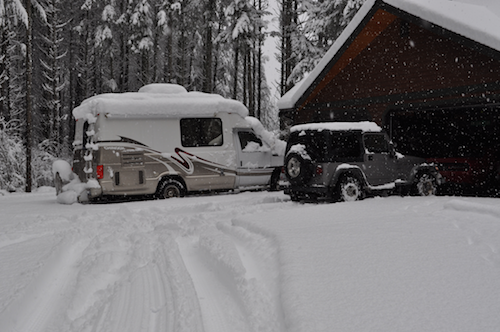
How to set up outlets to run on solar?
-
Norman&Michele
- Posts: 28
- Joined: October 4th, 2017, 1:05 pm
How to set up outlets to run on solar?
Happy Summer Chinook Tribe! I have a question that I could not seem to find an answer to in poking around older posts. We have a 2002 Concourse with one solar panel and 2 batteries for storage. As we all know, the solar panel powers everything but the microwave, AC, and the 110 outlets. In all of my binge watching on YouTube and other van camper folks, I see many that can use their 110 while boondocking, and it looks like an inverter is necessary, which I don’t believe we have. Is this something that could be installed and allow us to use our outlets while boondocking? I realize that the batteries will drain at a quicker rate, but we can cross that road when we come to it, Thank you for any of your wisdom! Michele
Norman&Michele
'Vinnie' the 2002 Chinook Concourse
'Vinnie' the 2002 Chinook Concourse

Re: How to set up outlets to run on solar?
Yes and no (ha, isn't that always the answer?)
To make the built-in 110 outlets work when boondocking you need an inverter that's hooked into them. But for various reasons, that's not so simple (although it can be accomplished). Easier is either with a whole house inverter/charger (big/expensive and to be proportional you need a large battery bank and solar array); or, with a smaller stand-alone inverter that has its own outlets. With the latter the inverter is kept as a separate sub-system.
Now, all that said, you really can't run a microwave on a "small" house battery and an even smaller solar panel (the stock panel is more suited to keeping the batteries topped up when the rig is stored). Microwave takes big power, and not only that but there is the Peukert effect, which essentially means that on lead-acid batteries a large load for a short time is more deleterious than a smaller load for a longer time. It kind of socks them in the stomach, if you will.
Just as a totally ballpark figure, I'd say you'd want something along the lines of 200-400 watts of solar, a 250+ amp hour battery bank (at least), and of course an inverter to run a microwave. To run the roof air you need an extremely large system, which while it could be done on a Chinook, is in a whole 'nother league.
Now, if you just want to do smaller things, such as charge a laptop, a toothbrush battery, or that sort of thing - you can do that now with a small inverter (say 100 watts or less) that you can plug into a cigarette lighter. These sorts of loads also won't go crazy on your smaller system (given some restraint).
If you are willing to do the math (or have someone else do it), and you want to be creative to do certain tasks, you can come up with a unique solution. For example, I have just a few power hungry loads that I run very infrequently (once every couple months for ten minutes or so). I wanted to set up to not use the generator for those (I may remove it). What I did was install a 1500 watt stand-alone modified sine wave inverter. I had already beefed up the main trunk systems with larger cable and proper fusing (including a 1/0 cable on the combiner wire between start and house bank). Even though I have a large battery bank (375 amp hours), I still didn't want to put huge Peukert type loads on it. Instead what I do for those occasional times is start the engine, activate the combiner (I have it on a manual switch), and then run my loads. In this way the load is split between the alternator and my battery bank. But even then I'm talking about a vacuum cleaner for ten minutes, a heat gun for five minutes, or a power tool for five minutes or less.
But this is still a small percentage of my loads. I'd say 97% of what I do is natively DC (including charging my computer). Then 2% is tiny inverter things on a cigarette plug inverter (75 watts). The last 1% is loads on my hybrid inverter "system."
So, I don't mean to be discouraging - it can all be done, for sure. Where there is a will (and a budget) there is a way. But to run things like microwave, hair dryer, air conditioner, toaster, etc. off your batteries --- you need a larger system (battery bank, solar panels and controller), bigger wires, and proper fusing than comes on the Chinook, IMO. So it depends on how much you want to do these things.
To make the built-in 110 outlets work when boondocking you need an inverter that's hooked into them. But for various reasons, that's not so simple (although it can be accomplished). Easier is either with a whole house inverter/charger (big/expensive and to be proportional you need a large battery bank and solar array); or, with a smaller stand-alone inverter that has its own outlets. With the latter the inverter is kept as a separate sub-system.
Now, all that said, you really can't run a microwave on a "small" house battery and an even smaller solar panel (the stock panel is more suited to keeping the batteries topped up when the rig is stored). Microwave takes big power, and not only that but there is the Peukert effect, which essentially means that on lead-acid batteries a large load for a short time is more deleterious than a smaller load for a longer time. It kind of socks them in the stomach, if you will.
Just as a totally ballpark figure, I'd say you'd want something along the lines of 200-400 watts of solar, a 250+ amp hour battery bank (at least), and of course an inverter to run a microwave. To run the roof air you need an extremely large system, which while it could be done on a Chinook, is in a whole 'nother league.
Now, if you just want to do smaller things, such as charge a laptop, a toothbrush battery, or that sort of thing - you can do that now with a small inverter (say 100 watts or less) that you can plug into a cigarette lighter. These sorts of loads also won't go crazy on your smaller system (given some restraint).
If you are willing to do the math (or have someone else do it), and you want to be creative to do certain tasks, you can come up with a unique solution. For example, I have just a few power hungry loads that I run very infrequently (once every couple months for ten minutes or so). I wanted to set up to not use the generator for those (I may remove it). What I did was install a 1500 watt stand-alone modified sine wave inverter. I had already beefed up the main trunk systems with larger cable and proper fusing (including a 1/0 cable on the combiner wire between start and house bank). Even though I have a large battery bank (375 amp hours), I still didn't want to put huge Peukert type loads on it. Instead what I do for those occasional times is start the engine, activate the combiner (I have it on a manual switch), and then run my loads. In this way the load is split between the alternator and my battery bank. But even then I'm talking about a vacuum cleaner for ten minutes, a heat gun for five minutes, or a power tool for five minutes or less.
But this is still a small percentage of my loads. I'd say 97% of what I do is natively DC (including charging my computer). Then 2% is tiny inverter things on a cigarette plug inverter (75 watts). The last 1% is loads on my hybrid inverter "system."
So, I don't mean to be discouraging - it can all be done, for sure. Where there is a will (and a budget) there is a way. But to run things like microwave, hair dryer, air conditioner, toaster, etc. off your batteries --- you need a larger system (battery bank, solar panels and controller), bigger wires, and proper fusing than comes on the Chinook, IMO. So it depends on how much you want to do these things.
1999 Concourse
Re: How to set up outlets to run on solar?
Michele,
With yours being a 2002 I would be shocked in you don't have a inverter. Look under the kitchen sink that's where mines at. I have a 600 watt Triplite inverter.
In mine when you open the overhead compartment there are two 110 plugs and another under the dinette. Those are the only ones that run off of my inverter. The other one's run off of shore power.
I have 200 watts solar and a 20 amp MPPT controller and 600 watts inverter and 425 amp hours of batteries. We run two laptops, charge cell phones and watch TV and we do fine.
If you want to run microwaves and AC (install a soft start) it can be done. But our coaches are small.That stuff will take a lot of room. Your better off just run the generator when you have too and find a RV park for the night and plug in.
Andy
With yours being a 2002 I would be shocked in you don't have a inverter. Look under the kitchen sink that's where mines at. I have a 600 watt Triplite inverter.
In mine when you open the overhead compartment there are two 110 plugs and another under the dinette. Those are the only ones that run off of my inverter. The other one's run off of shore power.
I have 200 watts solar and a 20 amp MPPT controller and 600 watts inverter and 425 amp hours of batteries. We run two laptops, charge cell phones and watch TV and we do fine.
If you want to run microwaves and AC (install a soft start) it can be done. But our coaches are small.That stuff will take a lot of room. Your better off just run the generator when you have too and find a RV park for the night and plug in.
Andy
-
Norman&Michele
- Posts: 28
- Joined: October 4th, 2017, 1:05 pm
Re: How to set up outlets to run on solar?
Thank you both for your input. Unfortunately, our model doesn't have an inverter (I just ran out and looked under the sink--nada--and then in the fuse box--just a converter in fuse box (??)). We wouldn't want an inverter for the AC or microwave--just maybe the toaster, and an electric pot we use. We can run our generator for those needs. In the grand scheme of things, it is good for the generator to get a few hours here and there. We plan to do some boon-docking this upcoming weekend, and planning a few other boon-docking camping adventures this summer, so we can get a firm understanding of what is what without shore power. This is because boon-docking is our plan when we head to AZ from VT for our this upcoming December. Truck stops and rest stops...ahh, the glamour.
Norman&Michele
'Vinnie' the 2002 Chinook Concourse
'Vinnie' the 2002 Chinook Concourse
Re: How to set up outlets to run on solar?
Norman and Michele,
Sounds like you have a solid plan for now. That is, use the generator if you need to (and if you are in an appropriate location) for the large loads. BTW, anything that makes heat is generally a huge load (for DC). So toaster, etc. are a breeze on AC, but a big deal on DC.
You *can* set up your system to run just about anything you want - but it sounds like you probably don't want to do that right now, but instead were just wanting to understand what you can do as things stand now.
If you want to be able to understand what constitutes a large or small load, you can do this:
1) Look on the appliance for the power consumption in watts. This is almost always on a label.
2) Divide by your voltage. For DC you can make it simple in your head and just use 10 volts, but if you are using a calculator you can use 12.
3) The corollary to this is that for AC you divide the same wattage by 110 or so.
So let's take the microwave for an example. Off the top of my head a "1,000 watt" microwave will probably actually take 1200 watts or more to run (this figure is on the label). So for DC, 1200 ÷ 10 = 120 (or ÷ 12 = 100). Yes, that's 100 amps Considering that your typical 21-footer native house bank is something like 200 amp hours, and that you generally want to stay above 50% discharge, you see the problem. Now, of course you aren't running the microwave for an hour. And five minutes would be only around 10 amps. BUT, there is that pesky Peukert factor I mention earlier, which means that a big "punch to the gut" like a microwave takes a much larger toll on lead acid batteries.
On the other hand, that same microwave running on AC only draws (1200 ÷ 110) 11 amps. So simple when on AC power!
Using this same formula you can see that a 100 watt light bulb (in the good old pre-LED days) would take around 9 amps DC, but less than 1 amp AC.
So anyway, if you look on your toaster (bottom side usually has label), or other appliances, you can get a good idea of how much power they draw. Anything that makes heat is typically going to be a larger draw, as a rule of thumb.
Since most cigarette outlets are only rated for around 15 amps, any little inverter that plugs into those will only be something like 150 watts. But 150 watts will easily charge phones, AA batteries, and many laptops. So that's an easy solution. (Still not as efficient as just using straight DC, so do use that when you can.)
Sounds like you have a solid plan for now. That is, use the generator if you need to (and if you are in an appropriate location) for the large loads. BTW, anything that makes heat is generally a huge load (for DC). So toaster, etc. are a breeze on AC, but a big deal on DC.
You *can* set up your system to run just about anything you want - but it sounds like you probably don't want to do that right now, but instead were just wanting to understand what you can do as things stand now.
If you want to be able to understand what constitutes a large or small load, you can do this:
1) Look on the appliance for the power consumption in watts. This is almost always on a label.
2) Divide by your voltage. For DC you can make it simple in your head and just use 10 volts, but if you are using a calculator you can use 12.
3) The corollary to this is that for AC you divide the same wattage by 110 or so.
So let's take the microwave for an example. Off the top of my head a "1,000 watt" microwave will probably actually take 1200 watts or more to run (this figure is on the label). So for DC, 1200 ÷ 10 = 120 (or ÷ 12 = 100). Yes, that's 100 amps
Considering that your typical 21-footer native house bank is something like 200 amp hours, and that you generally want to stay above 50% discharge, you see the problem. Now, of course you aren't running the microwave for an hour. And five minutes would be only around 10 amps. BUT, there is that pesky Peukert factor I mention earlier, which means that a big "punch to the gut" like a microwave takes a much larger toll on lead acid batteries.On the other hand, that same microwave running on AC only draws (1200 ÷ 110) 11 amps. So simple when on AC power!
Using this same formula you can see that a 100 watt light bulb (in the good old pre-LED days) would take around 9 amps DC, but less than 1 amp AC.
So anyway, if you look on your toaster (bottom side usually has label), or other appliances, you can get a good idea of how much power they draw. Anything that makes heat is typically going to be a larger draw, as a rule of thumb.
Since most cigarette outlets are only rated for around 15 amps, any little inverter that plugs into those will only be something like 150 watts. But 150 watts will easily charge phones, AA batteries, and many laptops. So that's an easy solution. (Still not as efficient as just using straight DC, so do use that when you can.)
1999 Concourse