Welcome!
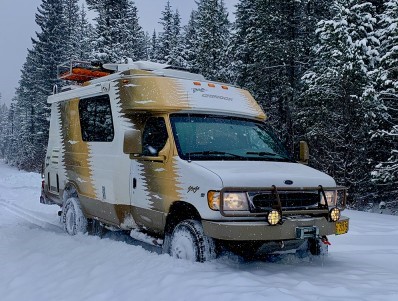
Well, the Chinook may not be for everyone, but they are really nice RV's if they suit your purposes. Not to minimize your potential issues, but just think how you'd feel if you'd bought a big fancy Class A. They are wonderful machines, no doubt about it, but just a set of tires is like $5000! (vs. $1500 for our wee Chinooks). And the list goes on.
So let's look at your issues.
Slight miss under acceleration.
Could be a number of things (and I'm not a mechanic), but when I bought mine it had that issue, and it was the plug coil boots (or whatever they are called). I could look back to see the cost, but I don't remember it because it was part of a number of repairs I rolled into the purchase offer. Still, I'd remember if it had been huge. These engines don't have a distributor and spark plug wires to carry the spark to each plug; rather it all happens right on top of each plug (so it's not wires).
Exhaust smell in cab.
This *could* mean you need an expensive manifold replacement (although I always thought the main symptom was loud ticking on acceleration as you hear the leak). But it could also just mean that the "doghouse" was not seated correctly the last time. You will have a console (cup holder) in between the seats. That's a decorative bit that slots down onto the "doghouse," which is the actual engine cover. Yes, half the engine is in the cab with you (but not as much as the old days). If you search for a thread I made that's called something like "console options for 1997 and newer) you will see the doghouse and how the console attaches to it. Once you have the console off (easy), then you can look at the rubber seal at the bottom of the doghouse. Sometimes it gets twisted or has a gap. The doghouse has two latches on the floor and two on the side (by the side of your ankle). Counterintuitively, I have found it works better when putting it in place to do the side latches first, then the bottom ones. There are some year variations, but mine has two "ski boot type" latches on the sides, and the bottom ones sort of look like butterflies. The way the butterfly ones work is you rotate them 180º. You will see a raised metal lip on the floor where the doghouse rides, and the bottom of the doghouse has a rubber seal that has lips. IIRC, the bottom lip rides on the metal lip, and the upper one goes over the carpet. Main thing is to make sure it's sitting in place correctly.
Shimmy in front end:
A few different things could cause this, but the first thing I would do is check the date code on the tires. If they are near six years old (or older), then they really should be replaced (it's all about age on RV's), so you could start there and that might fix your problem. My previous camper van (basically the same, but an E-250) shimmied horribly the whole way home after I bought it. It was the tires. If you Google you can see good descriptions and illustrations about how to read the tire date code, but just so you know it's only on one side of the tire (hopefully the side you can easily see) and it has a format of week/year. So for example 4911 would mean the 49th week (December) of 2011. Time to replace.
If not the tires, then we can go on. Could be other suspension components, but at around 50k that's less likely. One other problem Ford steel wheels can have is being bent (but if you get new tires that should show up). (Or you may have Alcoa aluminum wheels if a PO has added them.)
I agree about finding an independent mechanic. I "had" to have a Ford dealer do some of the initial work on my rig (I was away from home, plus it was rolled into my deal with the sellers), but geez, they were expensive and they muffed up a bunch of stuff (and that dealer got good reviews!). If you want to let us know your general location, someone here might have a recommendation [edited to add: I see you are in Maine, missed that on the first read through].
Oh, just so you know, the chassis is an "E-350" (E means Econoline van and 350 means one-ton) and the engine is a V-10 (also known as 6.8 liter). Just mentioning that as the engine has nothing to do with the 350 in this case). You also might need to specify that it's a dually for some parts (dual rear wheels), as the E-350 can also have single wheels (usually in a regular van).
So glad to have you, and I hope you will enjoy your Chinook as much as I do mine

We have a nice and helpful crew here, so bring it on!
BG