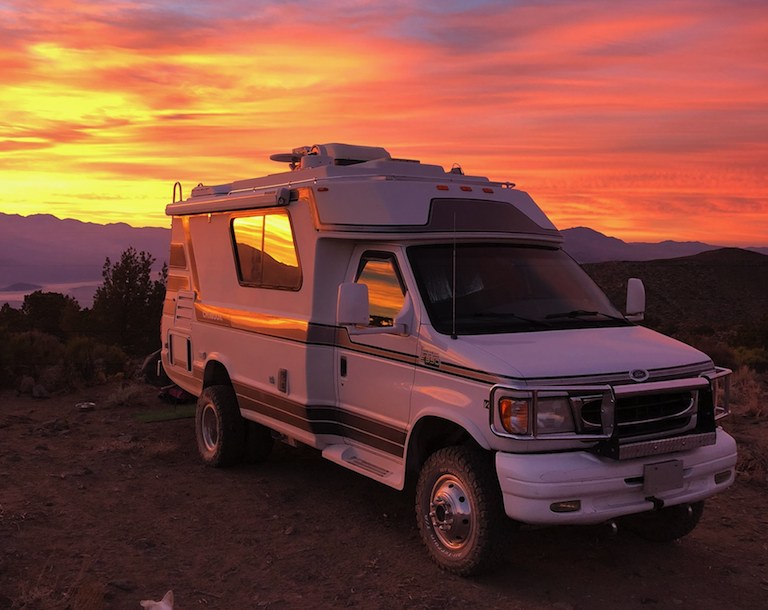

Plusses to this is it is super simple to get started with. No mounting panels, cutting holes, running wires down pillars, etc. Two you can park in the shade. And three if you do add roof panels (as I am doing right now), the ground panels are still useful for those delicious shady parking spots. Oh, four is that you can spend the money incrementally.
There are two negatives I can think of. One is that you have to store the panels. This had me thinking for a long time that ground panels would not work. But I found that with the thin/light flexible type panels (that actually aren't to be flexed, but that doesn't matter in this case), I can store a pair of them right against the back of the driver's seat and it's almost like they are not there. Other options I considered were the bathroom wall, or behind the couch back. The other "thing" is that you then don't have solar while you are driving, or on certain stops (WalMart, etc. where you aren't going to put them out). This hasn't been a huge problem for me, as I can go a couple three days no problem, but it is a slight problem. I compensate by of course being at 100% when I leave a camp spot. Then I will combine my batteries through the bulk stage, so they stay up at 85%. And then I get the panels out when I stop again at the next camp.
But.... I'm adding roof panels for just those "problem" times. Traveling for a few days, I will no longer need to combine at all, which is fine by me since the alternator is "stupid charging" (my precious batteries!
 ). And Wal-Mart or etc. I'll still be solar charging. And lastly, I would prefer not to put the ground panels out for the first night/day in a new site (in case I don't end up liking it and want to move), and/or for one or two night stops. Once I have the roof panels added, I'll only be putting the ground panels out when I park in the shade (which I hope is often!).
But quick/easy bang for the buck, it's hard to beat the ease of installation (if you can even call it that) of the ground panels. My setup:
1) Two 100 watt "flexible" (now called "lightweight" I think) panels. I think they were around $200 apiece, but panel prices have come down - not sure what they are now.
2) A single, 35' 8AWG Ancor duplex umbilical (I hate to give away power to voltage drop!). This has a pair of MC4 connectors on the outside end, where I connect to the panels. 25' of this is "outdoors-able." This just runs in through the "mouse hole" door my rig has for the shore power cord. When I'm not using the panels (or only using a short bit of the umbilical), the rest of the cord lives in that shore power cord storage area.
This same 8AWG duplex wire simply runs out into the rig (behind kitchen sink area) and to my solar controller (if I wanted to, I could have all 35' outdoors-able, then use a larger gauge wire for the 10' to the controller) (may do that in future, is why I started with the one 35' cable). There are ring terminals on the end where it connects to the solar controller (Morningstar Sunsaver 15 MPPT).
The panels are connected in series (which you can do with an MPPT controller) is how I can have such a long, relatively small wire, and little voltage drop. The controller then handles taking in the higher voltage and spitting out just what the batteries want.
A couple of short cables from controller to positive/negative bus. The solar display panel just takes a "click" phone type cord. And the temperature compensation cable is just a thin wire that easily connects in place.
And bingo, I haven't plugged in in well over a year (except for one time when I was "staying in" a friend's garage type building, with very little sun). But as long as I'm outdoors, I haven't had any issues getting back up to 100% just about every day.
(There is also a switch, and to be more deluxe you could have a disconnect on the coach end as well, but that can be added later.)
One thing I forgot to mention in the previous post (how COULD I?!) is battery monitoring. I would put that way up high on the list. Especially once you get AGM batteries (but for now, your plan works without it). The solar controller display gives you a pretty good idea where you stand too, so there is that, once you have it.