HEATING THE INTERIOR DURING THE WINTER
HEATING THE INTERIOR DURING THE WINTER
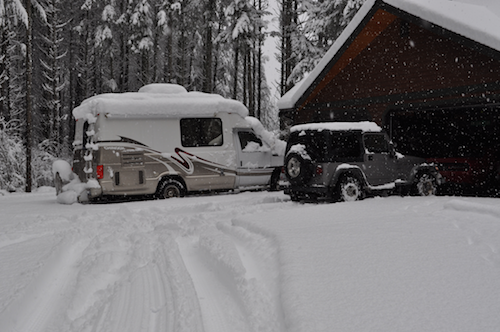
Hello! For those of you in the colder climates, do you hook up to shore power during the winter to keep the inside warm? If so, do you use the heat pump, propane, combination? Or another heat source? And what temperature setting do you recommend? Thanks!
Re: HEATING THE INTERIOR DURING THE WINTER
It depends.
If I am on a camp site with full hookup, I will use the heat pump, so I do not need to use my LP. Unless it was so cold (near freezing) that the heat pump is not going to work well. In that case, I usually pull out an ceramic heater and plug it into the AC outlet.
If I am out in the boonies, I usually use the LP. Temp usually high enough to keep from freezing. If I want it hot, I'll either drive to the Death Valley in August, or go home.
If I am on a camp site with full hookup, I will use the heat pump, so I do not need to use my LP. Unless it was so cold (near freezing) that the heat pump is not going to work well. In that case, I usually pull out an ceramic heater and plug it into the AC outlet.
If I am out in the boonies, I usually use the LP. Temp usually high enough to keep from freezing. If I want it hot, I'll either drive to the Death Valley in August, or go home.
2000 Concourse dinette, on 1999 6.8L Ford E350 Triton V-10 Chassis
Re: HEATING THE INTERIOR DURING THE WINTER
Hi, I camp alot in winter. Just got back from short overnighter. I boonedock on my trips (fishing) I use the LP furnace to heat rig. Overnight temps Friday were in mid-high 20's, day time temps low 30's. I put furnace on 72 to heat up quickly, it does take time to get nice and warm from freezin.
Once rig warm I keep at 68 - 70, but sleep at 68. It is so nice waking up in warm rig I find keeping temp above 68 it gets too warm, even when below freezin temps.
I should mention, I have a thick curtain to separate the coach from the camper section, this helps prevent heat loss to coach.
Once rig warm I keep at 68 - 70, but sleep at 68. It is so nice waking up in warm rig
I find keeping temp above 68 it gets too warm, even when below freezin temps.I should mention, I have a thick curtain to separate the coach from the camper section, this helps prevent heat loss to coach.
2001 Concourse XL Lounge model, 6.8L Ford E350 Triton V-10 Chassis.
Re: HEATING THE INTERIOR DURING THE WINTER
You seems to have an affinity to all thing 68, even when it come to sleeping temperature 
Too bad our thermostat is not that advanced, otherwise, I would think that 65 or even 60 F is fine when we are asleep. It will be perfect to ramp up the temperature back to around 68F maybe 15 minutes before waking up. It probably will save you 10 or 20% in LP.
Too bad our thermostat is not that advanced, otherwise, I would think that 65 or even 60 F is fine when we are asleep. It will be perfect to ramp up the temperature back to around 68F maybe 15 minutes before waking up. It probably will save you 10 or 20% in LP.
2000 Concourse dinette, on 1999 6.8L Ford E350 Triton V-10 Chassis
Re: HEATING THE INTERIOR DURING THE WINTER
Sorry....what I meant to ask was when you got the RV winterized and parked, do you plug it in an electrical source to maintain interior heat? Or do you hook it up to another LP source? Or do you use something else? Or do you just not worry about it until the snow starts to melt? Thanks!
Re: HEATING THE INTERIOR DURING THE WINTER
If properly winterized, there should be no need to maintain heat, and it will be a waste to use electricity or LP to heat the interior.
If you do live in an area with above-freezing temperature 99% of the time, and do not want to add RV anti-freeze to your plumbing, and have access to shore power, then it is possible to set an electric heater to maintains temperature above 40F or so, to prevent the water in the pipe from freezing.
If there are frost or snow, then you should winterize, or store it in a climate-controlled facility. I bet it will cost more to heat the interior of the Chinook for the winter than a constructed facility more than 1000 sq ft.
If you do live in an area with above-freezing temperature 99% of the time, and do not want to add RV anti-freeze to your plumbing, and have access to shore power, then it is possible to set an electric heater to maintains temperature above 40F or so, to prevent the water in the pipe from freezing.
If there are frost or snow, then you should winterize, or store it in a climate-controlled facility. I bet it will cost more to heat the interior of the Chinook for the winter than a constructed facility more than 1000 sq ft.
2000 Concourse dinette, on 1999 6.8L Ford E350 Triton V-10 Chassis
Re: HEATING THE INTERIOR DURING THE WINTER
Interesting you bring up indoor climate controlled building. I'm in the beginning step of creating just that in my area (Delmarva Peninsula). I believe that there are a large number of RV owners to support the business. Each RV would have about 600' of space, 20amp circuit and heat...no AC. While I'm looking at buildings I'm doing market research on what monthly fees the market would support. If you are interested, I'll keep you updated. Thanks
Re: HEATING THE INTERIOR DURING THE WINTER
Most people use a RV storage here because a lot of HOAs do not allow RV parking on our driveway. Vast majority of people parked on their driveway if they have the space. It is Southern California, so we don't need much climate control, but the sun really can take a toll on the exterior, so the careful owners usually cover their rig.
For Delaware, I think the cost of the building will be the main issue. If the land is cheap, then it may not be very accessible to the owner. I think for storage facility, the top three important factors are location, location, and location
I would think that the cost between a 20 A service and a 30/50A service is minimum for commercial building, so it maybe better to go with the higher amperage... just something that bothers me if I need to use an adapter on shore power.
For Delaware, I think the cost of the building will be the main issue. If the land is cheap, then it may not be very accessible to the owner. I think for storage facility, the top three important factors are location, location, and location
I would think that the cost between a 20 A service and a 30/50A service is minimum for commercial building, so it maybe better to go with the higher amperage... just something that bothers me if I need to use an adapter on shore power.
2000 Concourse dinette, on 1999 6.8L Ford E350 Triton V-10 Chassis
Re: HEATING THE INTERIOR DURING THE WINTER
Good pickup, I did not notice the 68 connection...haha.chin_k wrote: January 31st, 2021, 8:20 pm You seems to have an affinity to all thing 68, even when it come to sleeping temperature
Too bad our thermostat is not that advanced, otherwise, I would think that 65 or even 60 F is fine when we are asleep. It will be perfect to ramp up the temperature back to around 68F maybe 15 minutes before waking up. It probably will save you 10 or 20% in LP.
You are right, I wish I had smart thermostat that could be set to go lower at certain time then kick-in higher 15-30 min before waking up.
2001 Concourse XL Lounge model, 6.8L Ford E350 Triton V-10 Chassis.

Re: HEATING THE INTERIOR DURING THE WINTER
I park mine in my driveway. I'm in Seattle, and it does get below freezing sometimes. I've never used on-shore power for heat, and never had a plumbing freezing problem. But I am considering plugging in to keep the batteries charged.
2000 Ford E-350 415CI/6.8L V-10 Triton Superduty 4X4 Chinook Concourse XL Club Lounge