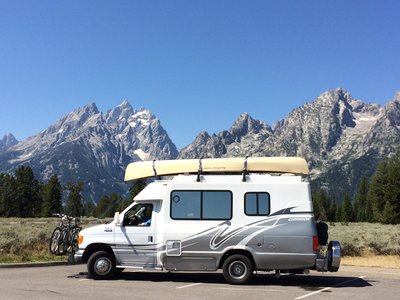
I was thinking of upgrading my 2001 e-350 engine alternator to a at least a 300 AMP from the stock 130.
Does anyone know how much faster a larger alternator will charge coach batteries or how to figure it out? Is it simply equal to percentage increase in amps? Also, since I charge my coach batteries by starting engine for an hour or so without driving it, would I need a high idle kit so I get the full amperage from the new alternator as opposed to lesser amps from lower idle speed?
Thanks
Larger Amp Alternator
Larger Amp Alternator
2001 Concourse XL Lounge model, 6.8L Ford E350 Triton V-10 Chassis.
Re: Larger Amp Alternator
You are limited by how fast you can push the electrons into the battery. The important thing is that you don't want to have too high of voltage, otherwise, it will generate gas, and dangerous.. need to stay below 14.4 volt. You need to look at how many Amp*hour your batteries are. If you have a larger alternative, it may enable you to charge faster, if the controller on the alternator let you. The alternator have a chip in there that control the voltage, and I assume it also control when to turn on the alternator (if the batteries are full, it turns off the coil on the alternator so that it won't be taxing the engine so you will be wasting gas).
I assume you do not have a generator? It is much more efficient to charge up the battery than using the engine. The charger is also more advance that what is possible compare to the alternator circuity.
Sorry about the babbling, I don't really know the answer, but you should be able to talk to the Ford people that selling the alternator about the charge time. Or even better is for you is to monitor the state of charge of your batteries, since I think running your engine for an hour is way too long to charge them at 130A. I think the best thing for you to get a meter and test it on your setup There is no purpose to turn on a fire hydrant to fill a water bottle.
I assume you do not have a generator? It is much more efficient to charge up the battery than using the engine. The charger is also more advance that what is possible compare to the alternator circuity.
Sorry about the babbling, I don't really know the answer, but you should be able to talk to the Ford people that selling the alternator about the charge time. Or even better is for you is to monitor the state of charge of your batteries, since I think running your engine for an hour is way too long to charge them at 130A. I think the best thing for you to get a meter and test it on your setup There is no purpose to turn on a fire hydrant to fill a water bottle.
2000 Concourse dinette, on 1999 6.8L Ford E350 Triton V-10 Chassis
Re: Larger Amp Alternator
Thanks Chin and you are not babbling, you give me good direction to look into. I have two 6-volt 220ah batteries, AGM. I have generator but rarely use it since I try to keep noise down, running engine is much quieter.
Since my solar gets little sun, and now that winter fishing season is starting I usually let engine idle to recharge batteries if I am using lots of battery power and want to make sure furnace stays working overnight so I don't wake up freezing or Low Voltage Alarm going off at 4 am...haha.
I figure a higher output alternator will allow me to charge batteries faster, provided as you say everything else allows it.
Since my solar gets little sun, and now that winter fishing season is starting I usually let engine idle to recharge batteries if I am using lots of battery power and want to make sure furnace stays working overnight so I don't wake up freezing or Low Voltage Alarm going off at 4 am...haha.
I figure a higher output alternator will allow me to charge batteries faster, provided as you say everything else allows it.
2001 Concourse XL Lounge model, 6.8L Ford E350 Triton V-10 Chassis.

Re: Larger Amp Alternator
Alot of para-transit and ambulance vans around that time were outfitted with larger aftermarket alternator setups. The two most common were penntex and leece-neville. Both require wiring modifications to make them work but they are in the 300+ amp range for rapidly recharging batteries on high electrical demand vehicles. I was thinking about installing a penntex setup on my chinook that I pieced together from leftover stuff from my work. I know Ford had a factory dual alternator option. I have a couple buses in the fleet that has that setup. Don't think its worth the pain to make a factory dual alt setup if it didn't come with it. Dual alts require pcm management.
Rich
2000 Concourse 7.3L Powerstroke 4X4
2000 Concourse 7.3L Powerstroke 4X4
Re: Larger Amp Alternator
Since you do not need that much space, it maybe cheaper and easier to add a battery or two to your coach setup and just charge them up at home. Adding second or larger alternator may not benefit you as much as you think. How low does your current setup get when you wake up in the morning? no juice left in the middle of the night, or not that bad? How many night do you want to go without turning on your genset/engine?
(If I don't mind the hassle of modify with a second/larger alternator, I may as well redo the electric with lithium instead. I will try to avoid that as much as possible, and try to keep my batteries in good shape and able to hold full capacity.)
(If I don't mind the hassle of modify with a second/larger alternator, I may as well redo the electric with lithium instead. I will try to avoid that as much as possible, and try to keep my batteries in good shape and able to hold full capacity.)
2000 Concourse dinette, on 1999 6.8L Ford E350 Triton V-10 Chassis
Re: Larger Amp Alternator
A few things to consider.
For fastest charging and best battery life, you want the charging algorithm to be fairly intelligent. This is why people switched over their Charger/Converters from the models in the 1990's to mid-late 2000's to the ones with "smart Wizard charging".
Alternators in general will not be putting out more than maybe half their rated power at engine idle. Your best charging will be while driving down the highway at a decent constant speed.
Having a larger alternator does mean it could handle pushing more amps to the coach for charging. But, does not mean it will push more amps to the coach. This is because the coach and engine batteries are hooked together with the alternator, and most alternator's have a simplistic charging algorithm - something like around 14.4V until it decides the battery is full enough to switch over to 14.2V or maybe 13.8V (that seems to be what my alternator does). The coach deep cycle batteries if lead acid want about 14.8V when low, then maybe 14.4, then less when at 90% or something and go into float mode.
1) Using a single engine alternator limits you to the charging the starter battery needs, so 14.4V at most. This will not give you a fast charge with a lot of amps to your coach batteries. Voltage determines how forcefully electricity is 'pushed' to the batteries. Then the state of the batteries determines how many amps the battery is willing to receive at that voltage.
2) I never really looked into them because my engine is already crowded enough, but I believe dual alternators can be configured so one alternator charges the engine and the other charges the coach. Then if you've bought a high-end alternator with built-in intelligent charging controller, it can give lots of amps to the coach (provided the engine revs are decent, not at idle).
3) Adding a Battery-to-Battery charger, like Sterling B2B chargers for boats and RVs, will allow for good and fast charging of the coach. They work by putting the B2B in-line between the alternator and coach batteries (I put mine after my isolator). Then the B2B takes whatever the incoming voltage is from the alternator, 14.4V or 14.2V or 13.8V, and increases the voltage according to its smart programmable charge algorithm and reading of the state of the coach batteries, and sends that to the coach. Because the coach sees, say, 14.8V it will charge properly and at high amps. This is not a free lunch, the increased voltage comes at decreasing the amps coming in from the alternator (e.g. the alternator is seeing 40 amps being output, but the coach batteries are getting 30A coming in, with the lost amps going to upping the voltage, and losses in the B2B during the conversion process itself).
I added a Sterling B2B charger years ago and went from barely charging the coach while driving to charging at a much better rate than my (upgraded Wizard) charger/converter. That was with stock 130A alternator (from 1998). I recently upgraded to a 200A alternator, mostly because my engine was open getting its spark plugs, etc, replaced and the labor to swap in a new alternator at the same time was almost nothing, so bigger and newer just seemed like a good idea.
Note if you do install a B2B, it is one-way only. So even though my isolator might be 2-way, after putting the B2B along the path to the coach batteries, I can no longer jump start the engine from coach. I meant to rig a switch to allow bypassing the B2B so I could jump start if needed, but have so far not done it.
4) If you don't have the usual Lead Acid coach batteries, which basically matches your engine battery type, then using just a normal alternator with cheap lead acid charging algorithm isn't a good idea. Do NOT use straight alternator charging if you switch to Lithium!
For fastest charging and best battery life, you want the charging algorithm to be fairly intelligent. This is why people switched over their Charger/Converters from the models in the 1990's to mid-late 2000's to the ones with "smart Wizard charging".
Alternators in general will not be putting out more than maybe half their rated power at engine idle. Your best charging will be while driving down the highway at a decent constant speed.
Having a larger alternator does mean it could handle pushing more amps to the coach for charging. But, does not mean it will push more amps to the coach. This is because the coach and engine batteries are hooked together with the alternator, and most alternator's have a simplistic charging algorithm - something like around 14.4V until it decides the battery is full enough to switch over to 14.2V or maybe 13.8V (that seems to be what my alternator does). The coach deep cycle batteries if lead acid want about 14.8V when low, then maybe 14.4, then less when at 90% or something and go into float mode.
1) Using a single engine alternator limits you to the charging the starter battery needs, so 14.4V at most. This will not give you a fast charge with a lot of amps to your coach batteries. Voltage determines how forcefully electricity is 'pushed' to the batteries. Then the state of the batteries determines how many amps the battery is willing to receive at that voltage.
2) I never really looked into them because my engine is already crowded enough, but I believe dual alternators can be configured so one alternator charges the engine and the other charges the coach. Then if you've bought a high-end alternator with built-in intelligent charging controller, it can give lots of amps to the coach (provided the engine revs are decent, not at idle).
3) Adding a Battery-to-Battery charger, like Sterling B2B chargers for boats and RVs, will allow for good and fast charging of the coach. They work by putting the B2B in-line between the alternator and coach batteries (I put mine after my isolator). Then the B2B takes whatever the incoming voltage is from the alternator, 14.4V or 14.2V or 13.8V, and increases the voltage according to its smart programmable charge algorithm and reading of the state of the coach batteries, and sends that to the coach. Because the coach sees, say, 14.8V it will charge properly and at high amps. This is not a free lunch, the increased voltage comes at decreasing the amps coming in from the alternator (e.g. the alternator is seeing 40 amps being output, but the coach batteries are getting 30A coming in, with the lost amps going to upping the voltage, and losses in the B2B during the conversion process itself).
Code: Select all
Alternator  amps   Battery-2-Battery   Coach   example amps
  14.4V     5A     not using one       14.4V     5A
  14.4V     40A    14.4->14.8          14.8V     30A or so
Note if you do install a B2B, it is one-way only. So even though my isolator might be 2-way, after putting the B2B along the path to the coach batteries, I can no longer jump start the engine from coach. I meant to rig a switch to allow bypassing the B2B so I could jump start if needed, but have so far not done it.
4) If you don't have the usual Lead Acid coach batteries, which basically matches your engine battery type, then using just a normal alternator with cheap lead acid charging algorithm isn't a good idea. Do NOT use straight alternator charging if you switch to Lithium!
2000 Concourse, Ford Triton 6.8 V10
Re: Larger Amp Alternator
Alternator chip are usually pretty rudimentary, and charging with it is usually accepted as "free lunch" while driving down the road. I don't think it is a good deal just to turn on the engine and let it idle for hours if you just want to use it to charge the batteries, consider that you have a genset. Maybe look into muffler that may quiet down the generator? I rather not to add more wear and tear on the V10 if I don't have to, and idling is one of the worst thing to do to it. The generator, on the other hand, is great for running 25-75% load.
Anyway, as Bob said, if you do want to go with lithium, it will need to be done on a system level with a lot of rework. It is much simple to add more batteries if you have the room and weight to your rig. Sounds like since you are mostly using it by yourself, instead of taking 8 other people with you ( ), I think you have plenty of capacity to do that.
Anyway, as Bob said, if you do want to go with lithium, it will need to be done on a system level with a lot of rework. It is much simple to add more batteries if you have the room and weight to your rig. Sounds like since you are mostly using it by yourself, instead of taking 8 other people with you (
), I think you have plenty of capacity to do that.2000 Concourse dinette, on 1999 6.8L Ford E350 Triton V-10 Chassis
Re: Larger Amp Alternator
Actually now that I have my electrical system set up properly and more knowledgeable I don't have that problem, but now that we are in winter I will be staying in rig from probably 6pm to 6 am with furnace on so I can see getting low, especially the second night if I am fishing same place two days in a row.chin_k wrote: December 3rd, 2020, 9:26 am Since you do not need that much space, it maybe cheaper and easier to add a battery or two to your coach setup and just charge them up at home. Adding second or larger alternator may not benefit you as much as you think. How low does your current setup get when you wake up in the morning? no juice left in the middle of the night, or not that bad? How many night do you want to go without turning on your genset/engine?
(If I don't mind the hassle of modify with a second/larger alternator, I may as well redo the electric with lithium instead. I will try to avoid that as much as possible, and try to keep my batteries in good shape and able to hold full capacity.)
Quicker coach batter charge would help at idle.
2001 Concourse XL Lounge model, 6.8L Ford E350 Triton V-10 Chassis.
Re: Larger Amp Alternator
Bob, thanks for all the info and thoughtful response. I definitely do not want to go lithium right now. I wanted to avoid the dual alternator since it seemed more complicated than single.
If I get the larger won't a high idle kit get rpms up high enough to get much more amps to coach battery than at idle? I will look into this further and if juice isn't worth squeeze I will look at dual alternator route.
Thanks
If I get the larger won't a high idle kit get rpms up high enough to get much more amps to coach battery than at idle? I will look into this further and if juice isn't worth squeeze I will look at dual alternator route.
Thanks
2001 Concourse XL Lounge model, 6.8L Ford E350 Triton V-10 Chassis.
Re: Larger Amp Alternator
Since it sounds like your main concern is heat while winter fly fishing, maybe easiest to upgrade your furnace. The original fan in our furnaces is really inefficient and there are much better options out there these days—like Airxcel nt-sq models or propex hs2800. I’ve had my eye on doing this mod (seems pretty straightforward), but I haven’t pulled the trigger. If you do go this route, I’ll be interested in hearing how it works for you.
David
David