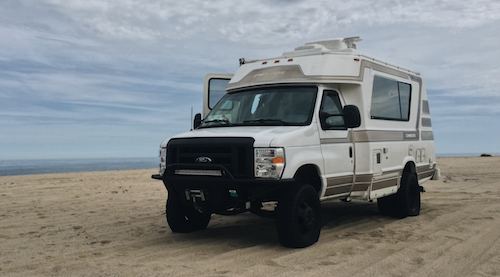
After driving in a flat for who knows how long, I'm looking for some sort of tpms. The electronic ones are cool and I may look into those when it's time for new tires/wheels. For now, I stumbled in to this style at an auto parts store. They only had car tire pressures in stock, but amazon carries everything. Question is, what pressure do people run?
http://www.amazon.com/Quick-Pressure-PS ... em+caps+rv
Tire pressure indicators

Re: Tire pressure indicators
This depends on the weights you have on each axle. (I also went into some detail on the thread I started about extended valve stems.) Essentially, within a given tire size/type, varying amounts of air correspond to various loads (weight) on them. Up to the max recommendation (I believe that is 80# on my tires). Running either less or more air in the tires for a given load is not advantageous, hence weighing and then inflating accordingly. (Not counting things like "airing down" on sand; but I'm speaking of typical road driving.)Manitou wrote:Question is, what pressure do people run?
Here is a copy of a generic chart. I believe most manufacturers are pretty similar for the same size/type of tire. I hope it is readable - it was not large to begin with, and then I had to change it from .pdf to .jpg to upload it.
So, for example on my recent trip north (towing a trailer), I weighed and got the following figures:
Front axle, with me in driver's seat: 3,150#
Rear axle (includes trailer tongue weight on this trip): 7,200#
So, 3,150 ÷ 2 = 1,575# on each front tire = 40#
7,200# ÷ 4 = 1,800# on each rear tire = 52#
I have to admit that I have mental trouble running only 40# in the front tires (don't ask me why, but I do
 ), so I bumped it up a bit from that. I ran about 50# in the fronts and 55-60# in the rear (thus somewhat disobeying the chart). The ride was not harsh, and I have not seen extra tire wear in the center of the tread (I do keep an eye out though).
I guess the main thing is that there is no "one recommendation" for tire inflation, except that perhaps you could say for our rigs, being on the E-350 chassis, that they are probably all fairly close to max weight, and so you can pretty much guess the weight and then go accordingly. I like to weigh just to keep track of where I am, and see if I've made the rig lighter or heavier, etc.
I also keep track of my trailer weight and tire inflation the same way.
I have been considering a TPMS for both the Chinook and my trailer, but so far have just checked pressure each time before I head out, and taken temps at my fuel and rest stops. I'm reading up on TPMS though.
1999 Concourse
Re: Tire pressure indicators
So what have you been running in your chinook?
After some more reading, it seems like a loaded question. I think I'll shoot for 55 front, 60 rear. Maybe just 60's all around since they come in packs of 4 and have a 10% variable (I think 10%).
After some more reading, it seems like a loaded question. I think I'll shoot for 55 front, 60 rear. Maybe just 60's all around since they come in packs of 4 and have a 10% variable (I think 10%).
Re: Tire pressure indicators
I know what you mean about the "loaded question" part, because I have seen the same thing. The main "other" theories being that you should one, go by the door sticker; or, two, inflate to the max pressure on the tire sidewall. I don't agree with either of those. Here is why:
--The door sticker is an approximation. It's Trail Wagons/Ford's best guess as to what our axle loads would be and what tires we would run. It's a start. But we can do better than that, because we can know our actual loaded weight, and the exact tires we are running -- then read the inflation charts and go accordingly. This is how bigger rigs do it, and I believe it's the best way.
--The max pressure on the sidewall is, of course, the maximum pressure, not the recommended pressure. It would only be appropriate if you had the tires loaded to their max rating (we couldn't, and still be within our GVWR/GAWR on the E-350, at least with the LT 225/75R16 tires).
One note which I mentioned in the other thread (on extended stems), is that you don't want to "customize" the inflation for the load on each tire. Instead you want to weigh each axle entire, and then divide that figure by the number of tires, then use that amount for each tire's inflation (so all tires on a given axle are inflated the same). If the load on one side is majorly different than the other, it's better to adjust the load, not "customize" the tire inflation to compensate.
--The door sticker is an approximation. It's Trail Wagons/Ford's best guess as to what our axle loads would be and what tires we would run. It's a start. But we can do better than that, because we can know our actual loaded weight, and the exact tires we are running -- then read the inflation charts and go accordingly. This is how bigger rigs do it, and I believe it's the best way.
--The max pressure on the sidewall is, of course, the maximum pressure, not the recommended pressure. It would only be appropriate if you had the tires loaded to their max rating (we couldn't, and still be within our GVWR/GAWR on the E-350, at least with the LT 225/75R16 tires).
One note which I mentioned in the other thread (on extended stems), is that you don't want to "customize" the inflation for the load on each tire. Instead you want to weigh each axle entire, and then divide that figure by the number of tires, then use that amount for each tire's inflation (so all tires on a given axle are inflated the same). If the load on one side is majorly different than the other, it's better to adjust the load, not "customize" the tire inflation to compensate.
1999 Concourse
Re: Tire pressure indicators
Last year I ran ~67psi on all tires (F&R) on a 7,000+ mile ocean to ocean trip including sea level to 11,000 feet (2004 Concourse). Got an average of 11.6mpg with good all around handling and loaded for travel. All 6 tires had proper tread wear at both the begining and the end of that trip (same tread depth inside/center/outside, no scallop/feather/etc.). Things to consider with tires aside from proper inflation are load rating, contruction, reputation of the manufacturer, balancing, and the like.Manitou wrote:So what have you been running in your chinook?
After some more reading, it seems like a loaded question. I think I'll shoot for 55 front, 60 rear. Maybe just 60's all around since they come in packs of 4 and have a 10% variable (I think 10%).
One thing to be aware of is pressure gauges. Whether analog or digital. Expensive or inexpensive. They will all have several PSI of difference between each other. Which one is correct? Use the same gauge every time and do your visual and sound checks.
2004 Chinook Concourse (Sold and missed)
Re: Tire pressure indicators
That would be the inflation recommendation for around 4,800# on the front axle and 8,800# on the rear. (That would be around 2,000# over the GVWR, at least on my E-350 rig.) I'm curious why you chose that particular pressure, if you wouldn't mind sharing your reasoning. Or maybe you were running super heavy?
I do run slightly (5# or so) over recommendations, but still much less than you do - I'm at around 50-52# fronts and 55-60# rears. This is with around 3200# on the front axle and 7500# on the rear. The higher inflation figures are when I'm towing.
Edited to add: Oh, or maybe you have tires that are a different size than the typical LT 225/75 R16 - then the recommended inflation could be totally different -- if so, forget what I said above.
I do run slightly (5# or so) over recommendations, but still much less than you do - I'm at around 50-52# fronts and 55-60# rears. This is with around 3200# on the front axle and 7500# on the rear. The higher inflation figures are when I'm towing.
Edited to add: Oh, or maybe you have tires that are a different size than the typical LT 225/75 R16 - then the recommended inflation could be totally different -- if so, forget what I said above.
1999 Concourse
-
jeanie19

- **Forum Contributor**
- Posts: 72
- Joined: July 31st, 2014, 10:56 am
- Location: Whidbey Island, Washington
Re: Tire pressure indicators
[quote="Blue~Go"]I'm at around 50-52# fronts and 55-60# rears. This is with around 3200# on the front axle and 7500# on the rear for the typical LT 225/75 R16. The higher inflation figures are when I'm towing.
Thanks for the specifics. I've been comparing various recommendations of front from 50 to 70 and rear from 60 to 80 from the previous owner, Chinook, Costco and Les Schwab. Good go know that those are maximums when fully loaded. I intend to travel light with the weight fairly evenly distributed among the hatches so see the reasoning behind your figures of 50 front and 55 rear.
Thanks for the specifics. I've been comparing various recommendations of front from 50 to 70 and rear from 60 to 80 from the previous owner, Chinook, Costco and Les Schwab. Good go know that those are maximums when fully loaded. I intend to travel light with the weight fairly evenly distributed among the hatches so see the reasoning behind your figures of 50 front and 55 rear.
Jeanie K.
2000 Chinook Concourse
Plank flooring, Wave heater, CO cubby
2000 Chinook Concourse
Plank flooring, Wave heater, CO cubby
Re: Tire pressure indicators
I have noticed that there are many different "theories" about how much to inflate tires. Ones I have seen:
1) Go by the door sticker
2) Go by the max pressure rating on the tire (ouch)
3) Go by the weight of the axles and the tire maker's corresponding recommendation (which is nothing more than the amount of pressure that will best support a given weight).
#1, the door sticker, to me, is imprecise. It's Chinook's (or any other RV maker's) best guess at how much your rig might weigh when they are done building it and you are done loading it. But they don't really know (and indeed, even an individual rig might weigh more sometimes and less at other times).
#2, is the maximum allowable pressure, and would only be appropriate if one's rig was so heavy that all the tires were at their very max capacity (we are far, far from that, which is good!)
#3 is customized for what "your" rig weighs, and what the tire size you run needs to have in it to support that weight best. I don't know how you can do much better than that. You definitely don't want to run lower, and there is no reason to run a lot higher (although I run slightly higher, especially when towing).
To accomplish #3, you just go to a scale (see below). Once you have the total weight for the front axle, and the total weight for the rear axle, you take that number and divide it by the number of tires on that axle (so divide by two for front, and by four for rear), and then match up that number to one of the charts (I posted some above). Voila, there is the specific recommended tire pressure for your exact weight and tire size, not a generic guess.
More on scales:
Both Washington and Oregon are fantastic for this as you can go to any public (i.e. highway) scale that is not open for trucks/business, and the scale will be on and is free for the public to use*. So convenient and kudos to them for doing it! I like these as I've usually got the scale to myself, and can take my time, putz around with the trailer, if I'm towing, etc. Some scales are even arranged such that you can do right or left sides separately. Other states may be similar, but I only know about Washington and Oregon.
The way you use these "free" (taxpayer supported) scales in WA and OR is just look to see that they are not open for business (if they are I leave them for the folks who are busy/working). Then you just pull in. No-one will generally be there, but they leave the scales on and working and it's perfectly legit to use them. The ones I've been on in Washington (mostly one on Hwy 20 east of Anacortes, but also a couple of others) have a small booth next to the scale. You pull up and you will see a "separate" concrete platform (really just a level, cut out square) in the road, usually near the booth. Whatever is on that platform when you stop is what will be weighed. The number will usually show on a small display that showing out the window of the booth (you can see it from outside, although you might have to walk over to the window).
The ones I've been on in Oregon (many different ones, all on non-interstate highways) have been smaller ones. There is often no booth. You pull in the same as the others, and they have the same concrete square. But the scale numbers will show on an overhead display that's on a pole or support above and ahead of you. These are really handy as the numbers are easy to see right from the driver's seat. They weigh in around 50# increments, but seem to be accurate even for our small rigs as I have used several different ones within a few days of each other and they agreed. One time I stopped at one almost empty of fuel, then filled up in the next town and decided to run back just to see what difference a full vs. empty fuel tank made (previously I had always weighed with a full tank). I really like how you can take your time with no-one to rush you. You can write things down, re-weigh, or unhitch a trailer to check tongue weight, etc.
The CAT scales, on the other hand, are usually busy, with working truckers waiting in line. Also the call button is like 20' off the ground The cost is around $10 and you pull off the scale after weighing, then go inside to where the truckers pay for gas and pay your fee, then they give you a slip with the numbers on it.
1) Go by the door sticker
2) Go by the max pressure rating on the tire (ouch)
3) Go by the weight of the axles and the tire maker's corresponding recommendation (which is nothing more than the amount of pressure that will best support a given weight).
#1, the door sticker, to me, is imprecise. It's Chinook's (or any other RV maker's) best guess at how much your rig might weigh when they are done building it and you are done loading it. But they don't really know (and indeed, even an individual rig might weigh more sometimes and less at other times).
#2, is the maximum allowable pressure, and would only be appropriate if one's rig was so heavy that all the tires were at their very max capacity (we are far, far from that, which is good!)
#3 is customized for what "your" rig weighs, and what the tire size you run needs to have in it to support that weight best. I don't know how you can do much better than that. You definitely don't want to run lower, and there is no reason to run a lot higher (although I run slightly higher, especially when towing).
To accomplish #3, you just go to a scale (see below). Once you have the total weight for the front axle, and the total weight for the rear axle, you take that number and divide it by the number of tires on that axle (so divide by two for front, and by four for rear), and then match up that number to one of the charts (I posted some above). Voila, there is the specific recommended tire pressure for your exact weight and tire size, not a generic guess.
More on scales:
Both Washington and Oregon are fantastic for this as you can go to any public (i.e. highway) scale that is not open for trucks/business, and the scale will be on and is free for the public to use*. So convenient and kudos to them for doing it! I like these as I've usually got the scale to myself, and can take my time, putz around with the trailer, if I'm towing, etc. Some scales are even arranged such that you can do right or left sides separately. Other states may be similar, but I only know about Washington and Oregon.
The way you use these "free" (taxpayer supported) scales in WA and OR is just look to see that they are not open for business (if they are I leave them for the folks who are busy/working). Then you just pull in. No-one will generally be there, but they leave the scales on and working and it's perfectly legit to use them. The ones I've been on in Washington (mostly one on Hwy 20 east of Anacortes, but also a couple of others) have a small booth next to the scale. You pull up and you will see a "separate" concrete platform (really just a level, cut out square) in the road, usually near the booth. Whatever is on that platform when you stop is what will be weighed. The number will usually show on a small display that showing out the window of the booth (you can see it from outside, although you might have to walk over to the window).
The ones I've been on in Oregon (many different ones, all on non-interstate highways) have been smaller ones. There is often no booth. You pull in the same as the others, and they have the same concrete square. But the scale numbers will show on an overhead display that's on a pole or support above and ahead of you. These are really handy as the numbers are easy to see right from the driver's seat. They weigh in around 50# increments, but seem to be accurate even for our small rigs as I have used several different ones within a few days of each other and they agreed. One time I stopped at one almost empty of fuel, then filled up in the next town and decided to run back just to see what difference a full vs. empty fuel tank made (previously I had always weighed with a full tank). I really like how you can take your time with no-one to rush you. You can write things down, re-weigh, or unhitch a trailer to check tongue weight, etc.
The CAT scales, on the other hand, are usually busy, with working truckers waiting in line. Also the call button is like 20' off the ground
The cost is around $10 and you pull off the scale after weighing, then go inside to where the truckers pay for gas and pay your fee, then they give you a slip with the numbers on it.1999 Concourse
-
jeanie19
- **Forum Contributor**
- Posts: 72
- Joined: July 31st, 2014, 10:56 am
- Location: Whidbey Island, Washington
Re: Tire pressure indicators
Thanks for the very good info on weigh stations and how to use them and how to calculate tire inflation. Nice to know that "closed" actually means "open" for us, I would not have guessed that.
Always appreciate your sharing your research and tips.
Always appreciate your sharing your research and tips.
Jeanie K.
2000 Chinook Concourse
Plank flooring, Wave heater, CO cubby
2000 Chinook Concourse
Plank flooring, Wave heater, CO cubby