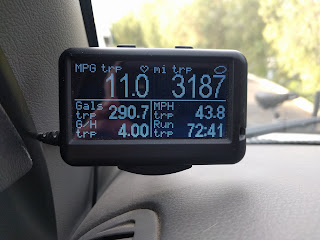
I'm not as familiar with the previous engine family (I have the V-10), but based on the towing I have done I would say some but not much, and it depends. Ha, conclusive aren't I?
I've towed a 4,500# boat, a 3,800# car and a 2,500# cargo trailer, for comparison.
Reason I say "not much" is that the big engines are capable of doing a lot, so it's not like you are taking a small/efficient engine and piling on. That's good (well, it's sort of bad, but you know what I mean). Then too, I think much of the gas mileage factor when on the highway is windage. You aren't really adding to that with a car (mine is completely within the wind-print of the Chinook, except maybe a little bit underneath isn't). So cruising along the highway it's not a big difference.
But going uphill you are pulling more, and around town too. I think in those situations it's a larger effect.
But to put it another way: I just about always get between 10mpg and 13 mpg in my Chinook. So the 10 mpg might be towing close to 5,000# up over mountains, and the 13 mpg not towing, not pushing the speed on the highway, no headwind, etc. That pretty much shows there is not a big difference. Maybe figure 1mpg?
On the actual hitch, I take it you plan to tow four-down. Here are some of the things I considered when setting up for my car:
1) Motorhome mounted tow-bar vs. car mounted tow bar.
Car mounted tow bars are getting rare, but there still are some. Since I have a rear entry, I thought this would be slick as it would be completely out of my way when parked. I got a Stowmaster All Terrain (used) to try it out. Turned out I didn't like it. I didn't like the big "thing" protruding from the front of the car all the time, and plus it rattled around when I was off pavement exploring. Also screamed "tow car" and I'd rather be just a person in a car when I'm driving the car around.
So then I considered the various motorhome mounted towbars. I had used a few towing friends cars for them, so had the basic idea. I thought since I might be removing it when camped (rear door), I'd go for a lighter one. I considered the Roadmaster Sterling All-Terrain, the Demco Dominator, and the Ready Brute as these were the lightest. (Blue Ox's aluminum model was barely lighter than some steel ones.)
With tow bars height is important. Most of them have some specification for how (if any) much higher or lower the car's baseplate attachment can be than the RV's receiver hitch. Basically they want to be level. You then accomplish this, if necessary, with a "raiser" or "lowerer" at the RV receiver hitch. With a motorhome mounted bar I didn't want one of these, as it's either one more thing to remove, and/or one more thing to step over. Also, I don't always tow the car, and then it's one more heavy chunk of steel to store and keep track of.
I had actually bought another car to use as a tow car but had not set it up at all when my friend's already set up car became available. But as it turns out that other car's baseplate would have been around 4" higher (you can see this spec on a baseplate website such as Blue Ox or Roadmaster) and would have necessitated a big chunky "raiser."
The reason I mention this is that is is part of how I chose the tow bar.
2) The tow bar:
The Demco Dominator was to my mind, the slickest design. It has a way to adjust the height built into it, the arms stay "up" when you are hitching up, and it has stowing options (gets a few petty minus points for the name and the gold color). But I didn't go with it because the knuckle that makes it height adjustable didn't work well with my receiver setup and/or would have presented a lower ground clearance point (just what I need: something new to scrape on driveways...).
The Ready Brute can be kind of nifty if starting from scratch, because one version (the Elite) has a surge brake built in. My car had already been a friend's tow car, so it already had a braking system and I didn't need that, but the tow bar can stand alone. I never tried one of these, I think because the bit that sticks out to "catch" the bar when stowed was in a bad place for my setup, but I can't remember all the details at the moment.
So the Roadmaster Falcon All-Terrain ended being the one I chose. It fit perfectly as stock with my receiver setup, it was almost exactly level with the existing baseplate on the car, and as an unexpected side bonus, it's not really too much in the way of the door when stowed, so I haven't ended up taking it on and off as I thought I might. I still might do that at some point, but what I've been doing so far is that I just removed and stored my flip down bottom step and I use a big/sturdy aluminum portable step. In some ways this is not as slick as the original step, but in other ways it's handy (I can move it someplace and use it to sit on, stand on it to wash windows, it's larger than the original step, etc.). I use it with a Blue Ox baseplate - the Blue Ox fit the slickest on the car (and was already on there anyway) -- it's basically tucked away under the front of the car when the tow bar isn't attached.
3) The Baseplate (on the car, for the tow bar to mount to)
Baseplate is another thing to choose. With your bug (or a Jeep type vehicle), you may have a custom baseplate, but for most "normal" vehicles, people choose one from a manufacturer (Blue Ox or Roadmaster, for example) and mount that. For most tow bars you can adapt from one to the other, so it's worth looking at which baseplate might be slicker on a particular vehicle (sometimes one is clunkier).
I liked the Blue Ox baseplate, because the Roadmaster on a friend's car had big honking plates that stuck out from the front of the car all the time, plus the tow bar had a big cross bar right in front of the car. I think Roadmaster may make some that don't protrude as much now, but you still may need the bar (Blue Ox accounts for the non-bar in the design). So I have the Roadmaster bar with Blue Ox "feet" and no crossbar (which is an option when you buy it from Roadmaster).
4) Then some kind of braking system. The simplest is probably something like the Ready Brute Elite where it is a surge brake built into the tow bar. Then there are some "boxes" that you place on the floor of the tow car and they operate the brake (but you have to place them and remove them every time you tow). Then there are "built in" systems of various types. My car came with the system i thought was the nicest (but might not have purchased myself) which is a built in vacuum based system that is proportional (Stay in Play). It is all contained in the car so it works no matter what vehicle is towing it (friend previously had a built in system that still required the controller in the RV, so the car wasn't "self contained" if someone else wanted to tow it, or if you had two towing vehicles you wanted to switch between).
I'm not sure about a box also. That would likely have to be some kind of custom setup. A tow car doesn't add any appreciable tongue weight, so you do have some to work with. My tow car is the storage box