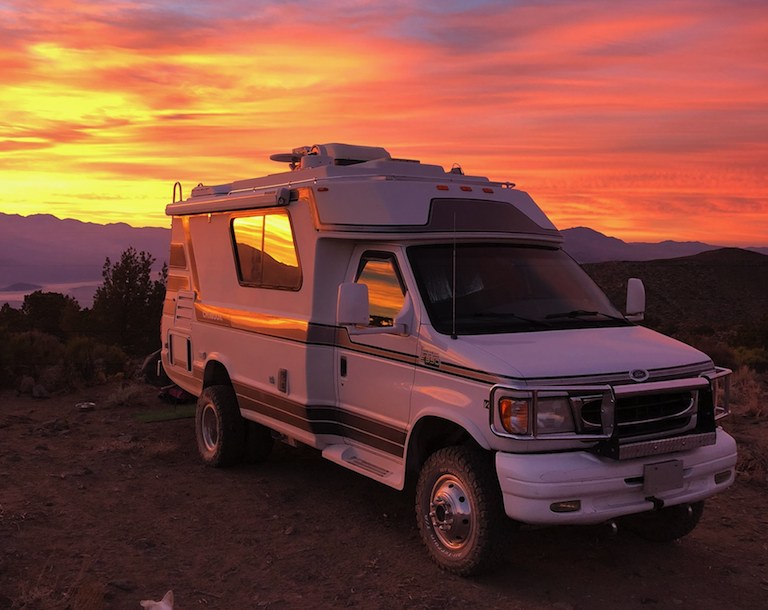
I am looking for some advice and counsel about using a Pure Sine Inverter that is wired directly to the House Batteries for charging while driving. In particular, I want to use an Aims 1000 watt pure sine inverter wired directly to the House Batteries to charge the Copenhagen Electric Wheels on our bicycles.
I have a heavy-duty alternator that puts out 150 amps and it is currently hooked to the House via a Blue Sea 7622 (still with the original 4awg wires...have yet to switch to 0/1 to help with voltage drop).
The House Battery Bank consists of two new Group 31 Duracell Ultra deep-cycle batteries with a rating of 105 ah each.
The wheel chargers draw a total of 230 watts, with 30.3 amps needed on the DC input side and 3 amps on the AC output side. The specs for the Aims inverter seem to be able to meet those requirements.
So, my question is: Will the alternator charging be able to allow for the charging taking place through the Inverter tied to the House Battery system? Will it be able to keep up without depleting the batteries? Or (as I hope), will it be able to not only provide the charge needed, but actually have enough power to continue to charge the batteries while I am driving.
Thanks to Blue-Go and others, I understand the non-smart and limited nature of alternator charging...but, for this particular purpose, if it works, I think it will be best for my current needs.
Any and all comments/questions/ advice most welcome!
Thanks
David
Hooking Inverter to House Batteries to charge while driving

Re: Hooking Inverter to House Batteries to charge while driv
I'm sitting here wrapping my mind around this as I type.
So for starters, the alternator puts out DC (I think maybe they actually put out AC and then something happens, but that's immaterial as for our purposes, they put out DC).
The inverter *takes* DC power, and changes it to AC power.
The house batteries charge via DC power.
You *could" take the DC from the Ford alternator, run it to an inverter (which produces AC), then run the inverter produced AC to a (hopefully smart) charger that would output DC to your batteries to charge them. But I'm slightly missing why you want to do all that converting back and forth if you are setting things up from scratch. Maybe it's something I'm not grasping about the bicycles (it is early in the morning for me ), but you mention wanting to charge your house bank "directly."
I have seen where someone used an inverter as an occassional thing to charge house bank via a smart charger they already had (vs. buying something new). But that was a sort of trial deal in lieu of buying and maintaining a generator for occasional use and to make use of an existing inverter and existing AC/DC smart charger (so the hood was opened, the inverter hooked up, and the charging done via idling the engine).
I'm probably missing something obvious, but if you want to use engine charging and make it better, what about a DC to DC charger like one of the Sterling products)? They are the DC equivalent of a shorepower type smart charger. So you'd be going
DC alternator output --->DC smart charger ---> DC input to house bank.
As opposed to
DC alternator output ---> DC Inverter with AC output ---> Charger with AC input and DC output ---> DC battery charging input.
Probably once I grasp it I'll be "Aha!-ing"
So for starters, the alternator puts out DC (I think maybe they actually put out AC and then something happens, but that's immaterial as for our purposes, they put out DC).
The inverter *takes* DC power, and changes it to AC power.
The house batteries charge via DC power.
You *could" take the DC from the Ford alternator, run it to an inverter (which produces AC), then run the inverter produced AC to a (hopefully smart) charger that would output DC to your batteries to charge them. But I'm slightly missing why you want to do all that converting back and forth if you are setting things up from scratch. Maybe it's something I'm not grasping about the bicycles (it is early in the morning for me
), but you mention wanting to charge your house bank "directly." I have seen where someone used an inverter as an occassional thing to charge house bank via a smart charger they already had (vs. buying something new). But that was a sort of trial deal in lieu of buying and maintaining a generator for occasional use and to make use of an existing inverter and existing AC/DC smart charger (so the hood was opened, the inverter hooked up, and the charging done via idling the engine).
I'm probably missing something obvious, but if you want to use engine charging and make it better, what about a DC to DC charger like one of the Sterling products)? They are the DC equivalent of a shorepower type smart charger. So you'd be going
DC alternator output --->DC smart charger ---> DC input to house bank.
As opposed to
DC alternator output ---> DC Inverter with AC output ---> Charger with AC input and DC output ---> DC battery charging input.
Probably once I grasp it I'll be "Aha!-ing"
1999 Concourse
Re: Hooking Inverter to House Batteries to charge while driv
Blue...thanks for such a prompt response.
Maybe I didn't lay this out as clearly as I thought I did (my wife will attest to that having happened on more than one occasion.
The lithium ion charger that charges the Copenhagen Wheel takes regular AC input (i.e.; you usually just plug it into a wall outlet on one end, and into the motor access port on the other). There is no AC back to DC transfer of power involved.
So, I plan on using the Aims 1000 watt pure sine inverter to take the DC power from my house batteries and convert it to AC power that I can then use for the lithium ion charger that charges the wheel.
The watt draw of the charger is 110-115 per wheel (so 230 for two wheels), and the amp input (by input I mean to the input end of the lithium ion charger) from the inverter is 2.2 amps per charger (so 4.4 amps for two wheels). NOTE: I misspoke about this in my earlier post...said 30.3 amps because I was thinking in 12v terms, when it is actually already 110--having been converted from DC to AC by the Inverter--my bad!).
So basically I am wanting to know if the alternator can keep up with a 230 watt, 4.4 amp draw from the out end of the inverter? And, in the process of doing that, will there be enough power coming into my Rig's House Battery Bank from the alternator to not only keep up, but continue charging my house batteries (however imperfectly the alternator charges...given that it is NOT SMART.
Does that make more sense?
If that will indeed work, then I am well on my way to having my cake and eating it too! Able to charge my Copenhagen Wheels while driving...and when at campsite, either using shore power directly (if around at a decent site), or by way of what I think is going to be my next purchase--a Goal Zero Yeti 400 watt Lithium Ion generator. I talked to the Goal Zero folks earlier this morning to confirm that new Lithium Ion model is indeed coming out (Feb 15th), and that it would work to charge my Copenhagen Wheels--with 120 watt solar input, it will charge one wheel at a time without depleting the batteries.
Let me know your thoughts...after second cup of coffee!
FYI...did you get my PM (way late response) to your check engine light code question?...short answer, I couldn't find what the actual code was...But, I am going to call Ford in Youngstown OH to see if they have it in their records...stay tuned.
David
Maybe I didn't lay this out as clearly as I thought I did (my wife will attest to that having happened on more than one occasion.
The lithium ion charger that charges the Copenhagen Wheel takes regular AC input (i.e.; you usually just plug it into a wall outlet on one end, and into the motor access port on the other). There is no AC back to DC transfer of power involved.
So, I plan on using the Aims 1000 watt pure sine inverter to take the DC power from my house batteries and convert it to AC power that I can then use for the lithium ion charger that charges the wheel.
The watt draw of the charger is 110-115 per wheel (so 230 for two wheels), and the amp input (by input I mean to the input end of the lithium ion charger) from the inverter is 2.2 amps per charger (so 4.4 amps for two wheels). NOTE: I misspoke about this in my earlier post...said 30.3 amps because I was thinking in 12v terms, when it is actually already 110--having been converted from DC to AC by the Inverter--my bad!).
So basically I am wanting to know if the alternator can keep up with a 230 watt, 4.4 amp draw from the out end of the inverter? And, in the process of doing that, will there be enough power coming into my Rig's House Battery Bank from the alternator to not only keep up, but continue charging my house batteries (however imperfectly the alternator charges...given that it is NOT SMART.
Does that make more sense?
If that will indeed work, then I am well on my way to having my cake and eating it too! Able to charge my Copenhagen Wheels while driving...and when at campsite, either using shore power directly (if around at a decent site), or by way of what I think is going to be my next purchase--a Goal Zero Yeti 400 watt Lithium Ion generator. I talked to the Goal Zero folks earlier this morning to confirm that new Lithium Ion model is indeed coming out (Feb 15th), and that it would work to charge my Copenhagen Wheels--with 120 watt solar input, it will charge one wheel at a time without depleting the batteries.
Let me know your thoughts...after second cup of coffee!
FYI...did you get my PM (way late response) to your check engine light code question?...short answer, I couldn't find what the actual code was...But, I am going to call Ford in Youngstown OH to see if they have it in their records...stay tuned.
David

Re: Hooking Inverter to House Batteries to charge while driv
Two wheel chargers = 230 watts = ~2 amps @ 110v, or ~20 amps @ 12v. With a typical 85-90% inverter efficiency rate, let's just round up to needing 25 amps @ 12v.
Using a safe half of your battery bank, you can do that for four hours even with the engine off. How long does it take for a wheel to charge? How long will you be driving? What other house loads do you have while driving?
As far as the 150 amp (at 1200+ rpm) alternator goes, about 50-90 amps will be used by the running vehicle (depending on headlights, taillights, HVAC blower, wipers), with the rest available for charging the house battery bank.
However, you don't want to continuously pull more than about 50-75% of the alternator max rating, to avoid overheating it. Depends on how heavy duty it is. Let's assume you can do 75% or 112 amps total. Subtracting 50-90 running amps leaves 22-62 amps to recharge the house batteries.
Sounds like you have enough to stay at equlibrium, depending on what else you're running in the house and front.
Kevin
Using a safe half of your battery bank, you can do that for four hours even with the engine off. How long does it take for a wheel to charge? How long will you be driving? What other house loads do you have while driving?
As far as the 150 amp (at 1200+ rpm) alternator goes, about 50-90 amps will be used by the running vehicle (depending on headlights, taillights, HVAC blower, wipers), with the rest available for charging the house battery bank.
However, you don't want to continuously pull more than about 50-75% of the alternator max rating, to avoid overheating it. Depends on how heavy duty it is. Let's assume you can do 75% or 112 amps total. Subtracting 50-90 running amps leaves 22-62 amps to recharge the house batteries.
Sounds like you have enough to stay at equlibrium, depending on what else you're running in the house and front.
Kevin
1994 Concourse dinette, Ford 7.5L (460 V8)

Re: Hooking Inverter to House Batteries to charge while driv
Kevin's numbers are correct.
The wheel should be charged @ 12v.
The wheel should be charged @ 12v.
1994 Premier
Re: Hooking Inverter to House Batteries to charge while driv
Since I've been away for a couple of days, this is more or less echoing what was stated above. But so what I'm reading now is the following, kind of laid out in steps.
1) You have a 1000 watt inverter that you'd like to hook up to your house bank.
2) You have a bicycle battery pack that you'd like to charge, and it takes 230 watts and typically charges via AC.
3) 230 watts is ~2 amps AC or ~20 amps DC.
4) You have a ~200 amp lead-acid battery bank.
So, a couple of things I'd want to know would be these:
1) What is the actual voltage the battery pack takes to charge (yes, it plugs into AC now, but that doesn't mean it actually charges via 110v - there may be some built in transformer or etc.). Is there any sort of "car" "airline" "cigarette" adapter sold for it? There may not be, because most cigarette plugs are only rated for around 15 amps. But... worth a check (maybe the actual charge rate would be less without the AC brick or whatever).
2) How long does the pack take to charge?
There is the Peukert effect which basically says that even though you could run a load of .5 amps for 100 hours (to use half your bank), that doesn't mean you could run a load of 50 amps for 2 hours. Basically, a larger load draw makes the batteries take it on the chin much more than a longer duration smaller load. (Lithiums don't have this issue, but most of us probably won't have those for another round or two of battery replacement.). Not that this directly applies as you are talking "only" 20 amps and only when you are running the engine (or plugged in), but just mentioning it in passing.
On the face of it, this looks potentially doable to me. Of course make sure you have good fusing, etc. Actually, you may not be able to fuse the line coming back to your house bank from the start battery given the smaller wire (not that that's a new situation with the setup under consideration).
I've been thinking about what I think might be a fiendishly clever solution to something that has been annoying me. Namely, carrying around a 180# generator in my best outside storage locker when I use it about ten minutes per month, on average. But I DO have a few tasks I like to use it for. These are short duration, infrequent tasks. For example: 30 seconds of heat gun to shrink tubing over electrical connections, 45 seconds of running a trim router, a minute or two of Multimaster tool, a few minutes of vacuuming.
I haven't executed this on my Chinook yet, but I did run a test on a friend's rig, who has the V-10 (same alternator), same heavy wire back to house bank, same AGM battery bank, same battery monitors, and a 2,000 watt inverter (I'd be doing 1,000 or 1,500 watts, but no matter as I had the same loads running either way). What I did was turn on the inverter, start the engine, combine the house and start banks (we both have manual switches for this, but same concept as 7622). Then I ran each of my tools and watched what happened. What I wanted to know was, would the alternator rise to meet much or all of the load?
What I observed was that it did. Watching the Victron amp counter meter, there was a range from none to very little draw on the house bank. Most of the power was coming from the alternator. In other words, nothing my house bank couldn't easily handle. (We're talking about draws of around 600 watts by the tools.) Not that I would use my engine for an "hours long" generator without driving - that's not good for an engine that wasn't designed to be doing this. But my scenarios are all in the 30 second to 2 minute range (especially after I get rid of the darned carpeting!). Not that this is exactly what you are proposing, but I thought I'd mention it as tangential to the subject at hand.
So you are talking about a smaller draw, over a longer period of time, and you won't be running an unloaded engine (because you'll be driving).
I don't know how your inverter hooks up, but I'd encourage a proper installation. Hard wired, good fusing on ample wires with not too much voltage drop, etc. And it would be nice to go to a wire size from the start battery that could actually be fused. In my experience, 2AWG is the bare minimum, and 1/0 is better. Reason I say that is that my buddy with the same engine/alternator/starter (2003 V-10), didn't want to run much larger wire, so decided to run 2AWG. With the purely recommended fuse size for that wire, a self-jump would blow the fuse. But invoking the "if you have to you can fuse a bit higher" rule (it's worded a bit differently of course), he was able to make it work. IIRC, it was a 175 that was too small, and a 200 that worked, but I'd have to check to be sure as this was a couple of years ago). He also has more voltage drop than he would with larger wise, but it's much better than the completely unfused 6AWG that he had originally.
I went with 1/0 (considered 2/0, which would not be bad either) and don't have any problem fusing within guidelines. I started with a 225 amp fuse, and kept a 250 in reserve in case that wasn't enough (1/0 can handle either no problem). 225 has been fine though.
Just for the record, the ampacity tables show that 4AWG (Chinook stock), if it's 105º C rated wire (most Chinook wire is, and I think the 4AWG was too), and since it's in an engine space (heat), it's rated for up to 136 amps (if not bundled). Even fusing 50% over that (ouch) is only just 200 amps. I believe that's why it's not fused in stock form. The 2AWG my friend used is rated to 178, which is why we first tried the 175 amp fuse. But it was too small to take the starter's load. So we went up to 200, which is still in the acceptable range, if not perfect (less than 20% over). The 1/0 can take a 242 amp fuse as rated, and I have had no problems even with a 225 amp fuse.
BTW, while not a ten minute job, running the new cable wasn't all that bad. This is also a perfect time to add a 7622 and place it somewhere besides the fenderwell (I know you already have a 7622), if so desired. Buying the larger cable is slightly ouchy, but coming from boating RV's always seem like a bargain (and I hear that airplanes make boats look cheap, so there's always that). One note is that in order to complete the circuit, you also need to have the negative wire. Chinook uses the frame (chassis) for that. BUT, the Ford start battery has a short little wire from the start battery negative to the chassis. So that will also want to be upgraded. That was actually harder than running the big long wire aft to the house bank! And there is the negative wire from the house bank to the chassis ground (that was pretty easy).
Okay, that was probably more than you wanted to read. But, cloudy morning, lounging around vs. starting tasks
As always, I'm not an electrician (not even close) - so if anyone sees any holes in my logic, please do mention them. I can always learn something and also don't want to steer anyone wrong.
1) You have a 1000 watt inverter that you'd like to hook up to your house bank.
2) You have a bicycle battery pack that you'd like to charge, and it takes 230 watts and typically charges via AC.
3) 230 watts is ~2 amps AC or ~20 amps DC.
4) You have a ~200 amp lead-acid battery bank.
So, a couple of things I'd want to know would be these:
1) What is the actual voltage the battery pack takes to charge (yes, it plugs into AC now, but that doesn't mean it actually charges via 110v - there may be some built in transformer or etc.). Is there any sort of "car" "airline" "cigarette" adapter sold for it? There may not be, because most cigarette plugs are only rated for around 15 amps. But... worth a check (maybe the actual charge rate would be less without the AC brick or whatever).
2) How long does the pack take to charge?
There is the Peukert effect which basically says that even though you could run a load of .5 amps for 100 hours (to use half your bank), that doesn't mean you could run a load of 50 amps for 2 hours. Basically, a larger load draw makes the batteries take it on the chin much more than a longer duration smaller load. (Lithiums don't have this issue, but most of us probably won't have those for another round or two of battery replacement.). Not that this directly applies as you are talking "only" 20 amps and only when you are running the engine (or plugged in), but just mentioning it in passing.
On the face of it, this looks potentially doable to me. Of course make sure you have good fusing, etc. Actually, you may not be able to fuse the line coming back to your house bank from the start battery given the smaller wire (not that that's a new situation with the setup under consideration).
I've been thinking about what I think might be a fiendishly clever solution to something that has been annoying me. Namely, carrying around a 180# generator in my best outside storage locker when I use it about ten minutes per month, on average. But I DO have a few tasks I like to use it for. These are short duration, infrequent tasks. For example: 30 seconds of heat gun to shrink tubing over electrical connections, 45 seconds of running a trim router, a minute or two of Multimaster tool, a few minutes of vacuuming.
I haven't executed this on my Chinook yet, but I did run a test on a friend's rig, who has the V-10 (same alternator), same heavy wire back to house bank, same AGM battery bank, same battery monitors, and a 2,000 watt inverter (I'd be doing 1,000 or 1,500 watts, but no matter as I had the same loads running either way). What I did was turn on the inverter, start the engine, combine the house and start banks (we both have manual switches for this, but same concept as 7622). Then I ran each of my tools and watched what happened. What I wanted to know was, would the alternator rise to meet much or all of the load?
What I observed was that it did. Watching the Victron amp counter meter, there was a range from none to very little draw on the house bank. Most of the power was coming from the alternator. In other words, nothing my house bank couldn't easily handle. (We're talking about draws of around 600 watts by the tools.) Not that I would use my engine for an "hours long" generator without driving - that's not good for an engine that wasn't designed to be doing this. But my scenarios are all in the 30 second to 2 minute range (especially after I get rid of the darned carpeting!). Not that this is exactly what you are proposing, but I thought I'd mention it as tangential to the subject at hand.
So you are talking about a smaller draw, over a longer period of time, and you won't be running an unloaded engine (because you'll be driving).
I don't know how your inverter hooks up, but I'd encourage a proper installation. Hard wired, good fusing on ample wires with not too much voltage drop, etc. And it would be nice to go to a wire size from the start battery that could actually be fused. In my experience, 2AWG is the bare minimum, and 1/0 is better. Reason I say that is that my buddy with the same engine/alternator/starter (2003 V-10), didn't want to run much larger wire, so decided to run 2AWG. With the purely recommended fuse size for that wire, a self-jump would blow the fuse. But invoking the "if you have to you can fuse a bit higher" rule (it's worded a bit differently of course), he was able to make it work. IIRC, it was a 175 that was too small, and a 200 that worked, but I'd have to check to be sure as this was a couple of years ago). He also has more voltage drop than he would with larger wise, but it's much better than the completely unfused 6AWG that he had originally.
I went with 1/0 (considered 2/0, which would not be bad either) and don't have any problem fusing within guidelines. I started with a 225 amp fuse, and kept a 250 in reserve in case that wasn't enough (1/0 can handle either no problem). 225 has been fine though.
Just for the record, the ampacity tables show that 4AWG (Chinook stock), if it's 105º C rated wire (most Chinook wire is, and I think the 4AWG was too), and since it's in an engine space (heat), it's rated for up to 136 amps (if not bundled). Even fusing 50% over that (ouch) is only just 200 amps. I believe that's why it's not fused in stock form. The 2AWG my friend used is rated to 178, which is why we first tried the 175 amp fuse. But it was too small to take the starter's load. So we went up to 200, which is still in the acceptable range, if not perfect (less than 20% over). The 1/0 can take a 242 amp fuse as rated, and I have had no problems even with a 225 amp fuse.
BTW, while not a ten minute job, running the new cable wasn't all that bad. This is also a perfect time to add a 7622 and place it somewhere besides the fenderwell (I know you already have a 7622), if so desired. Buying the larger cable is slightly ouchy, but coming from boating RV's always seem like a bargain
(and I hear that airplanes make boats look cheap, so there's always that). One note is that in order to complete the circuit, you also need to have the negative wire. Chinook uses the frame (chassis) for that. BUT, the Ford start battery has a short little wire from the start battery negative to the chassis. So that will also want to be upgraded. That was actually harder than running the big long wire aft to the house bank! And there is the negative wire from the house bank to the chassis ground (that was pretty easy).Okay, that was probably more than you wanted to read. But, cloudy morning, lounging around vs. starting tasks
As always, I'm not an electrician (not even close) - so if anyone sees any holes in my logic, please do mention them. I can always learn something and also don't want to steer anyone wrong.
1999 Concourse
Re: Hooking Inverter to House Batteries to charge while driv
I get that all,and even though I am not the resident guru,(that's never stopped me before)my head spinning from all those calculations...excuse me while I kiss the sky here (dreaming) So you've bought the fancy separator,inverter,Python wire.....and your boat is ready to sail....
I am reminded of the father of this all Tesla,in his lab in Colorado Springs experimenting creating lightning meanwhile faraway the power generating station in Amarillo is frying.....
GET TO THE POINT,
Ok ok,You have a more or less balanced,more or less stock chinook electrical system stop there...(leave it as is) Then have a seperate system yes it's expensive that crazy Kodiak system with the lithium battery,you run your tools maybe a refer,maybe you ditch the generator,maybe you rip up the carpet and install radiant wire for heat (beats forced air any day) etc etc or consider it a backup to your main system,or at 20lbs use in your house or trailer when necessary.
Ok ok I know voice in the wilderness,Carry on you can always scab together a harbor freight system for less.....or as Emily Latella used to say, 'Never mind'
Rooney
I am reminded of the father of this all Tesla,in his lab in Colorado Springs experimenting creating lightning meanwhile faraway the power generating station in Amarillo is frying.....
GET TO THE POINT,
Ok ok,You have a more or less balanced,more or less stock chinook electrical system stop there...(leave it as is) Then have a seperate system yes it's expensive that crazy Kodiak system with the lithium battery,you run your tools maybe a refer,maybe you ditch the generator,maybe you rip up the carpet and install radiant wire for heat (beats forced air any day) etc etc or consider it a backup to your main system,or at 20lbs use in your house or trailer when necessary.
Ok ok I know voice in the wilderness,Carry on you can always scab together a harbor freight system for less.....or as Emily Latella used to say, 'Never mind'
Rooney
Re: Hooking Inverter to House Batteries to charge while driv
Always good to stay open to new ways and ideas. I can't imagine that my next set of batteries wouldn't be lithium (of course we'll see when the time comes).
The Kodiak system is nifty, but wouldn't work for me. Well, I shouldn't say it wouldn't work, per se, but it's not really the best setup for the way I run my rig. It looks somewhat similar to other "solar generator" kits I've seen, and I could see it being really slick for, say, someone who is home all week (on the grid, charging it), and then wants to take off on the weekend in a friend's rig to the beach. Just pick up your pre-charged "generator" (I think that's a slightly misleading term, but anyway, there's nothing wrong with a battery pack, outlets, and inverter all in one, which is what it looks like to me - maybe not very catchy though, admittedly).
Once you have to buy solar panels to hook up to it, and then you only have this one "outlet station" as opposed to all the outlets and lights you already have in your RV that you could use with a typical system... well, it's not as attractive to me. But the component parts are very similar to what one might choose and install in the RV, and those would allow the RV to function "as per normal." To me where the Kodiak shines is if you need something really portable, and especially if you can usually get through the weekend without re-charging (then it really IS portable, vs. being a portable unit plus solar panels).
Where I don't see it being so great (just IMO) is the case where someone buys it just because "Whew, it's just one piece I can buy, and .... it says solar generator... that sounds cool." In that case it might lead to disappointment or inconvenience.
Basically, I don't see where it's anything magical beyond what the separate components would do; but it would be VERY handy if you need something really portable. Even better if you charge it on-grid and then just pack it out to use for a day or two.
Let's say I wanted a similar system, but components integrated into RV:
a) One 100 amp hour lithium battery (theirs is 90 ah). (I would likely want 200 amp hours, but with a component system you can have whatever suits). Check, that's no issue. Lithiums work a little differently than lead acid, so you can usually have fewer amp hours than you would "traditionally" need in your bank.
2) An inverter. Sure, you can get whatever size you need, or a small one for most uses (a 75 watt inverter charges 90% of what I use with very low tare load, and for <$50). Or go for a 1,000 watt inverter if you wish. One big plus to lithiums is they don't suffer from Peukert effect. In other words, a short blast with a huge load doesn't faze them like it does lead acid batteries (say 30 seconds of microwave oven). The Kodiak uses a 1,500 watt inverter. I would probably choose 1,000 or 1,500 watts if I bought a stand alone, but that's adjustable to suit.
3) Outlets, breaker panels -- those are already in the Chinook.
4) A means to recharge the batteries. The "solar generator" appears to use either AC from a power post or solar charging from panels and a charge controller that are "not included." Truly portable panels get pretty unwieldy if they are over 100 watts or so (I use 200 watts of portable panels, but they are not a suitcase or anything like that - just two 4# panels that are around 21" x 45".
So I don't see anything in the re-charging scenario that's any different than what would generally be in a Chinook. I don't know how "smart" the charger is in the Kodiak kit, but probably no-one is going to spend the coin for lithium batteries and try to charge them with a 1990's (or even modern day) stock RV charger.
I don't see any "free lunch" or magic in the Kodiak system. It still seems to obey the laws of physics And the downside is you can't use your normal RV outlets, lights, etc. Everything has to be plugged into the Kodiak box. Also you can't re-charge it as it stands, except from an AC power post. (You can add solar and a solar controller, just like with any system.) To me it would be great for that "weekend beach trip" in a friend's bare cargo van. Charge it at home, pack it along, and groove for a couple of days.
For many of the Kodiak's benefits, fewer of its downsides (in a Chinook), and some additional upsides (you can use the RV outlets, lights, etc.) I'd go to lithium batteries, a good charger, and an inverter. Add solar panels for more than a day away from a power post (or generator).
Disclosure: It does slightly stick in my craw how some companies use the term "solar generator." It doesn't even come with solar panels or a charge controller, for Pete's Sake (unless I'm missing something?). So there's no solar, and it's not a generator. But other than that no problem There is a another similar product I looked at a year or so ago when someone asked about it (not here). It was a Goal Zero, IIRC. It seemed like it had the same upsides and downsides.
What it looks like to me is a great little/big portable lithium power pack with a handle and a built in way to be charged via power post. Nothing wrong with that at all!
(If I'm missing anything, I'm ready to be corrected.)
The Kodiak system is nifty, but wouldn't work for me. Well, I shouldn't say it wouldn't work, per se, but it's not really the best setup for the way I run my rig. It looks somewhat similar to other "solar generator" kits I've seen, and I could see it being really slick for, say, someone who is home all week (on the grid, charging it), and then wants to take off on the weekend in a friend's rig to the beach. Just pick up your pre-charged "generator" (I think that's a slightly misleading term, but anyway, there's nothing wrong with a battery pack, outlets, and inverter all in one, which is what it looks like to me - maybe not very catchy though, admittedly).
Once you have to buy solar panels to hook up to it, and then you only have this one "outlet station" as opposed to all the outlets and lights you already have in your RV that you could use with a typical system... well, it's not as attractive to me. But the component parts are very similar to what one might choose and install in the RV, and those would allow the RV to function "as per normal." To me where the Kodiak shines is if you need something really portable, and especially if you can usually get through the weekend without re-charging (then it really IS portable, vs. being a portable unit plus solar panels).
Where I don't see it being so great (just IMO) is the case where someone buys it just because "Whew, it's just one piece I can buy, and .... it says solar generator... that sounds cool." In that case it might lead to disappointment or inconvenience.
Basically, I don't see where it's anything magical beyond what the separate components would do; but it would be VERY handy if you need something really portable. Even better if you charge it on-grid and then just pack it out to use for a day or two.
Let's say I wanted a similar system, but components integrated into RV:
a) One 100 amp hour lithium battery (theirs is 90 ah). (I would likely want 200 amp hours, but with a component system you can have whatever suits). Check, that's no issue. Lithiums work a little differently than lead acid, so you can usually have fewer amp hours than you would "traditionally" need in your bank.
2) An inverter. Sure, you can get whatever size you need, or a small one for most uses (a 75 watt inverter charges 90% of what I use with very low tare load, and for <$50). Or go for a 1,000 watt inverter if you wish. One big plus to lithiums is they don't suffer from Peukert effect. In other words, a short blast with a huge load doesn't faze them like it does lead acid batteries (say 30 seconds of microwave oven). The Kodiak uses a 1,500 watt inverter. I would probably choose 1,000 or 1,500 watts if I bought a stand alone, but that's adjustable to suit.
3) Outlets, breaker panels -- those are already in the Chinook.
4) A means to recharge the batteries. The "solar generator" appears to use either AC from a power post or solar charging from panels and a charge controller that are "not included." Truly portable panels get pretty unwieldy if they are over 100 watts or so (I use 200 watts of portable panels, but they are not a suitcase or anything like that - just two 4# panels that are around 21" x 45".
So I don't see anything in the re-charging scenario that's any different than what would generally be in a Chinook. I don't know how "smart" the charger is in the Kodiak kit, but probably no-one is going to spend the coin for lithium batteries and try to charge them with a 1990's (or even modern day) stock RV charger.
I don't see any "free lunch" or magic in the Kodiak system. It still seems to obey the laws of physics
And the downside is you can't use your normal RV outlets, lights, etc. Everything has to be plugged into the Kodiak box. Also you can't re-charge it as it stands, except from an AC power post. (You can add solar and a solar controller, just like with any system.) To me it would be great for that "weekend beach trip" in a friend's bare cargo van. Charge it at home, pack it along, and groove for a couple of days.For many of the Kodiak's benefits, fewer of its downsides (in a Chinook), and some additional upsides (you can use the RV outlets, lights, etc.) I'd go to lithium batteries, a good charger, and an inverter. Add solar panels for more than a day away from a power post (or generator).
Disclosure: It does slightly stick in my craw how some companies use the term "solar generator." It doesn't even come with solar panels or a charge controller, for Pete's Sake (unless I'm missing something?). So there's no solar, and it's not a generator. But other than that no problem
There is a another similar product I looked at a year or so ago when someone asked about it (not here). It was a Goal Zero, IIRC. It seemed like it had the same upsides and downsides.What it looks like to me is a great little/big portable lithium power pack with a handle and a built in way to be charged via power post. Nothing wrong with that at all!
(If I'm missing anything, I'm ready to be corrected.)
1999 Concourse
Re: Hooking Inverter to House Batteries to charge while driv
Excellent reply,there is another potential downside,(if not more)the convenience of that all in one expensive system becomes a nightmare if there is a failure say of one component and is it replaceable?at a reasonable price?....I am sure Boeing was convinced their Dreamliner batteries,or Samsung thought the technology was solid until things started to Fall apart.I am with you 100% on the name but guess they are attempting to approach a home owner and say hey this can maybe replace a backup generator,(which is a Generator).,,,, A couple points I like this in addition rather then a replacement to the stock 2 batteries (or 3 in your case) dedicated to certain tasks which might otherwise task a 2 battery stock system.....a 110 kitchen appliance and other extraneous but nice items....I could not agree more that the stock Onan is a noisy not to mention the need to be exercised when not in use.From my understanding the Kodiak is also chargeable by the alternator from the cigarette lighter (oops that's extra$$ cord)I tend to drive distances and my regular coach batteries recharge quickly,so maybe they are somewhat rechargeable on the go (depending on how you go)As for recharging by solar for someone who touts this product I should know more....I don't understand why you would need to use their panels (thought I read that) I now have a single 150 watt on the roof and it works great recharging my batteries...(I admit I live in the southwest solar area) point is I could set up another panel on the roof.....Interestingly enough I think it has an option to charge an agm additional battery (but alas once again I didn't investigate that further. I like my 2 agm battery system,I am hoping it will last and last going into my 3rd year (fingers crossed).But adding another system to it,especially if it's light weight,and dependable would be groovy especially if I could relieve some of the propane consumption tasks,,you already have that extra solar,and extra battery,and can run every task you need.But for folk who just have stock system and want to do more..don't have that true sine inverter etc etc.My thought is Maybe down the road soon this might be a feasible way to quickly upgrade their rigs without rewiring etc etc..As for the Goal Zero.....let me just say if someone does spring for that I am Itching to read their report to the forum.......Thanks for the focused reply, as ever,I have come to Respect your opinion (as you can imagine I always see the world a little different) Travel Well Always, Rooney
Re: Hooking Inverter to House Batteries to charge while driv
I thought the Kodiak has a "30A" RV socket that gives up to 10 amps.
If so, then you could plug the Chinook into that and run some things.
If so, then you could plug the Chinook into that and run some things.
1994 Concourse dinette, Ford 7.5L (460 V8)