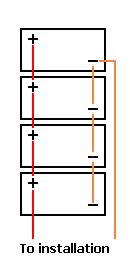
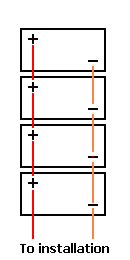
Okay, so a couple of things.
One is that I would change the jumper arrangement on your batteries to match the Method 2. Reason is otherwise the battery that both the cables are coming off of is doing most of the work, and the other one is coasting more. So you want the "final" negative cable and the "final" positive cable (the ones leading to your loads and charging) coming off opposite batteries.
Okay, on your solar, if you are seeing something like 36 volts and 5 amps (coming from the panels), that means your panels are hooked up in series. In series, the volts add up, and the amps stay the same (in parallel, the volts stay the same and the amps add up).
There is nothing wrong with having the panels in series - I have mine set up this way on purpose. So, ~36 volts goes into the charge controller (must be MPPT to do this) at around 5 amps. This is nice because I can have a 25' 8AWG wire leading out to the panels (I use them as ground panels) and still have very little voltage drop. Easy to put me in the shade and the panels in the sun that way. If I had the panels in parallel I'd have 10 amps coming in vs. 5 on that wire, and either too much voltage drop or change to a huge thick wire.
When my (approximately) 36 volts and 5 amps get to the solar controller, the MPPT controller works its magic, and what comes out the other side (leading to the batteries) is 13-15 volts (depending on charging stage and battery temp) and around 10 amps. Magic!
So, if you are seeing 36 volts on the panel side, you definitely have them wired in series. If you want that, great. If not, you should change the panel wiring to a parallel setup. Then you will see like 18 volts coming in from the panels (at twice the amps).
If you are seeing 36 volts on the battery side (coming OUT of the controller and going to the batteries), then perhaps your controller thinks you have a 24 volt battery system. This could be for a number of reasons.
1) It was "told" in the settings that that's what you have.
2) It auto-detected a 24-volt battery setup (which would seem to mean your batteries might be connected in series).
3) It's broken.
If you DO have your batteries in parallel (12 volts) and the controller is actually putting out 36 volts (my guess is it's not and something else is afoot), you may have ruined your batteries. That would be serious overcharging. But I bet it is something else,like maybe you were reading the display of what the panels were doing, not the solar controller (my display will show me either one, depending on which buttons I press). I'm happy to sleuth with you if you like.
Okay, back you you

BG
PS: Not that more solar is a undesirable, but you should be able to run the basics easily with 200 watts. Now, the panels won't put in more than the batteries can accept (plus your loads you are running at the time), but on days my batteries were "down" I've taken in 60 amp hours in a day. Not too shabby. I don't usually take in more than around 15-25, but that's simply because I don't use anymore than that most days so there is no place for it to "go" (power will only come in if it has a purpose - either filling up the batteries or running a load in real time, for our rigs). But anyway, 200 watts with little voltage drop and a good controller can give a lot of power (for modest demands of course).