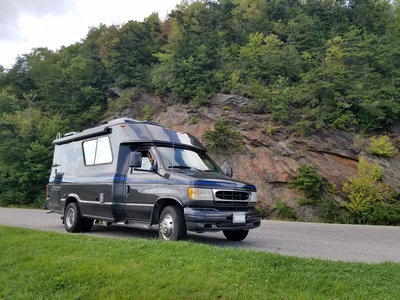
As mentioned previously, I have started a new topic here under projects/modifications on Supplemental Heat in effort to migrate on-going discussion on the topic that was previously under "Outside Storage."
My wife has nixed the idea of putting a Wave on face of front storage where VCR used to be (and where we now have art). 'I'd rather freeze" was her remark. So I am still looking for a "right" location. Jeanie's idea of between front seats facing back won't work for me, as it gets cluttered at night with clothes, shoes, and other things that we keep in easy reach from the bed when it is down. So, now I'm wondering about how it would work mounted on the outside wall between the window and stove counter on passenger side of the rig. There it would face the right direction and be easily accessible both daytime and night (with bed down). I'd have to put some blocking in that wall to hold it, and run propane line from existing heater somehow (suggestions?). But before doing all that, I have now promised my wife that we will try some boondocking this fall using just the stock heater and see how that goes. With the dual Group 27 house batteries we have, I am calculating just about 24 hours of heater use with fridge running all the time before batteries shut down. That may be doable since we wouldn't be running it all the time.
David
Supplemental Heat

Re: Supplemental Heat
I hear you on all counts. Here's another idea, to possibly implement while you are doing "phase one" of using the stock heater. Get either a Mr. Buddy or Coleman "cat" (neither of these are actually catalytic), and buy a few disposable one-pound cylinders. Yes, you still have to set it somewhere, but there is no hose, and it's a smaller footprint. Having the club chair layout, I had space across from the couch, but it could probably even go in the sink or something, if necessary. I have two varieties of this stove, which I use (carefully, at anchor) while boating.
1) This Little Buddy. It's easy to move around due to the big handle, and has a tall/thin footprint. Lights easily.

2) I sought out this "previous model" Coleman Cat because I like the way it is super stable, and when you take it apart the parts are very small and stowable. The current design is bulkier and has plastic arms that reportedly break. It was fairly easy to find one new-in-box on e-Bay. This design is is more stable. OTOH, if on the floor, the Little Buddy has a smaller footprint, so you may prefer that.

One canister will keep you cozy over a 24-hour period (I don't run mine while sleeping though, as I like it cooler). I'm not really a "disposable canister" person, myself, but you know..... it did work very well for a limited time period. I kept the canisters in an outside compartment (not connected to the indoors).
They have the canisters many places, but one that was easy and surprised me was Lowe's, which had packs of, IIRC, four at a reasonable cost (comparatively). Wal-Mart also has them, but were often out of the multi-packs and the singles were not as economical.
1) This Little Buddy. It's easy to move around due to the big handle, and has a tall/thin footprint. Lights easily.
2) I sought out this "previous model" Coleman Cat because I like the way it is super stable, and when you take it apart the parts are very small and stowable. The current design is bulkier and has plastic arms that reportedly break. It was fairly easy to find one new-in-box on e-Bay. This design is is more stable. OTOH, if on the floor, the Little Buddy has a smaller footprint, so you may prefer that.
One canister will keep you cozy over a 24-hour period (I don't run mine while sleeping though, as I like it cooler). I'm not really a "disposable canister" person, myself, but you know..... it did work very well for a limited time period. I kept the canisters in an outside compartment (not connected to the indoors).
They have the canisters many places, but one that was easy and surprised me was Lowe's, which had packs of, IIRC, four at a reasonable cost (comparatively). Wal-Mart also has them, but were often out of the multi-packs and the singles were not as economical.
1999 Concourse
-
caconcourse

- Senior Member
- Posts: 510
- Joined: October 31st, 2014, 10:25 pm
Re: Supplemental Heat
An important upgrade for reducing generator use when boondocking is to replace the stock Magnatek Power Converter with a replacement 3-stage charger, if you haven't done so already. The boost mode allows the generator to recharge low batteries much more quickly, saving hours of generator use. It also prevents overcharging, so you can leave your unit plugged in continuously without damaging the batteries.
This was one of my first upgrades, and I haven't needed any battery maintenance since it was installed. This is the Amazon link for the compatible Progressive Dynamics 3-stage (really 4-stage, with the equalization feature) converter. It was also pretty easy to install, as it was designed to replace the Magnatek unit and fits in the same chassis.
Progressive Dynamics (PD4645V) 45 Amp Converter/Charger with Built-In Charge Wizard
http://www.amazon.com/gp/product/B002OR ... ge_o08_s00
I know most people may have already upgraded their units, but I thought it would be useful to point out the benefits of reducing generator usage for those who haven't.
I also got a 3-stage solar charge controller and added a couple more 50W panels, which improved the solar charging efficiency, but that is another story.
Clay
This was one of my first upgrades, and I haven't needed any battery maintenance since it was installed. This is the Amazon link for the compatible Progressive Dynamics 3-stage (really 4-stage, with the equalization feature) converter. It was also pretty easy to install, as it was designed to replace the Magnatek unit and fits in the same chassis.
Progressive Dynamics (PD4645V) 45 Amp Converter/Charger with Built-In Charge Wizard
http://www.amazon.com/gp/product/B002OR ... ge_o08_s00
I know most people may have already upgraded their units, but I thought it would be useful to point out the benefits of reducing generator usage for those who haven't.
I also got a 3-stage solar charge controller and added a couple more 50W panels, which improved the solar charging efficiency, but that is another story.
Clay
Clay
2001 Concourse
Santa Barbara, CA
2001 Concourse
Santa Barbara, CA
Re: Supplemental Heat
David no sooner starts an "on point" thread when we proceed to wander.... heh. It's so easy though!
I agree with you that the original charger is highly deficient for a number of reasons, but one that is not often discussed is the feed wire (from batteries to charger).
This feed wire (unless changed at later date) is a very VERY long, #8 wire. This same wire is feeding the main DC fuse block. It goes back to the wall, up over the window, into the overcab, then down the pillar, then out to the batteries. This leads to a LOT of voltage drop. One of the reasons to get a smarter charger is to charge the batteries at the correct voltage, so if you then have a ton of voltage drop, it sort of defeats the purpose.
Just as an example, this #8 wire is around a 60 foot round trip run. Granted, you do have to give some credit for the return being a chassis ground part of the way (but part of the way it's #8 wire as well). So let's say it's a 40 foot round trip run. Then let's say we have 40 amps going in from the charger. Ideally we'd shoot for 1-2% voltage drop. This would mean that when, for example, the batteries want 14.4 volts, they'd actually be getting around 14.2 volts. Not ideal, but decent. Now let's do the same calculation with the Chinook long #8 wire. This gives 8.9% voltage drop at a 40 foot round trip and 40 amps. So again let's say the batteries want 14.4 volts. With this much voltage drop they actually get 12.8 volts. I think you can see the problem. This would occur even with the best new charger. It's just a factor of the amperage vs. the size of the wire vs. the distance.
If I were going to upgrade the "brown box" charger in its current location, I would run a new wire, likely along the back wall under the couch (behind water tank) and to the batteries through the floor. Then upgrade the chassis ground jumper leads to the same size as the positive wire (or just run both wires and don't use chassis ground) To achieve 1-2% voltage drop, and presuming a 32 foot round trip (which we will likewise "upgrade" to 20 feet to account for the chassis ground to keep examples parallel), #2 wire would give 1.1% voltage drop. Now the output from your smart charger can actually GET to the batteries.
I went a different route, and installed a separate marine charger. It's got a about a 20 foot round trip the batteries (for real, I'm not using a chassis ground). 99% of its voltage can get to the batteries. That said, with the 200 watts of portable solar panels, I have not needed to run the generator at all. I don't like to hear generators when I'm boondocking (it's very common these days though - hard to find a boondock where you can't hear someone's generator). Sorry if I sound cranky, but it's a peeve. (Not saying you do this though; some folks do make sure they are more than a mile or so from anyone else, and I thank them!)
Anyway, good point about a smart charger being the way to go, but I wanted to mention the wiring, because why buy a new charger, then throw away all that hard won amperage/voltage to losses in the wire. Also the ampacity is relatively low, especially when bundled with like 25 other wires as it is. Makes it hard to fuse high enough.
Just in case it sounds like I'm dissing Chinook, I've actually found that they did a pretty nice job compared to other RV's. Plus the expectation was to drive from hookup to hookup, mostly. And the state of things was not as advanced. But, things can be vastly improved, safety and efficiency wise.
Now, back to how to heat without running the generator
I agree with you that the original charger is highly deficient for a number of reasons, but one that is not often discussed is the feed wire (from batteries to charger).
This feed wire (unless changed at later date) is a very VERY long, #8 wire. This same wire is feeding the main DC fuse block. It goes back to the wall, up over the window, into the overcab, then down the pillar, then out to the batteries. This leads to a LOT of voltage drop. One of the reasons to get a smarter charger is to charge the batteries at the correct voltage, so if you then have a ton of voltage drop, it sort of defeats the purpose.
Just as an example, this #8 wire is around a 60 foot round trip run. Granted, you do have to give some credit for the return being a chassis ground part of the way (but part of the way it's #8 wire as well). So let's say it's a 40 foot round trip run. Then let's say we have 40 amps going in from the charger. Ideally we'd shoot for 1-2% voltage drop. This would mean that when, for example, the batteries want 14.4 volts, they'd actually be getting around 14.2 volts. Not ideal, but decent. Now let's do the same calculation with the Chinook long #8 wire. This gives 8.9% voltage drop at a 40 foot round trip and 40 amps. So again let's say the batteries want 14.4 volts. With this much voltage drop they actually get 12.8 volts. I think you can see the problem. This would occur even with the best new charger. It's just a factor of the amperage vs. the size of the wire vs. the distance.
If I were going to upgrade the "brown box" charger in its current location, I would run a new wire, likely along the back wall under the couch (behind water tank) and to the batteries through the floor. Then upgrade the chassis ground jumper leads to the same size as the positive wire (or just run both wires and don't use chassis ground) To achieve 1-2% voltage drop, and presuming a 32 foot round trip (which we will likewise "upgrade" to 20 feet to account for the chassis ground to keep examples parallel), #2 wire would give 1.1% voltage drop. Now the output from your smart charger can actually GET to the batteries.
I went a different route, and installed a separate marine charger. It's got a about a 20 foot round trip the batteries (for real, I'm not using a chassis ground). 99% of its voltage can get to the batteries. That said, with the 200 watts of portable solar panels, I have not needed to run the generator at all. I don't like to hear generators when I'm boondocking (it's very common these days though - hard to find a boondock where you can't hear someone's generator). Sorry if I sound cranky, but it's a peeve. (Not saying you do this though; some folks do make sure they are more than a mile or so from anyone else, and I thank them!)
Anyway, good point about a smart charger being the way to go, but I wanted to mention the wiring, because why buy a new charger, then throw away all that hard won amperage/voltage to losses in the wire. Also the ampacity is relatively low, especially when bundled with like 25 other wires as it is. Makes it hard to fuse high enough.
Just in case it sounds like I'm dissing Chinook, I've actually found that they did a pretty nice job compared to other RV's. Plus the expectation was to drive from hookup to hookup, mostly. And the state of things was not as advanced. But, things can be vastly improved, safety and efficiency wise.
Now, back to how to heat without running the generator
1999 Concourse
-
1998chinook
- Posts: 83
- Joined: August 1st, 2014, 2:32 pm
Re: Supplemental Heat
I have a Mr. Heater Big Buddy. I am going to give that a try this fall.
You can get a propane line adapter if you want to tap into the existing propane tank.
Mr. Heater also has an adapter called the Mr. Heater Stay A While that sits between the propane on/off knob and the regulator.
You can get a propane line adapter if you want to tap into the existing propane tank.
Mr. Heater also has an adapter called the Mr. Heater Stay A While that sits between the propane on/off knob and the regulator.
Re: Supplemental Heat
Holy Cow Bat Man! The information provided herein by Blue-Go and Clay on more efficient use of generator power is terrific! But it is going to take an electrically challenged person such as myself several reads to digest and comprehend it all. One question I have right off the bat: Since we have yet to Boondock for days without running the rig (to a trailhead, river so my wife can fly fish, or just to explore our surroundings), does what is being said here about long wire runs and more efficient converters apply to the alternator charging our Group 27 dual house batteries? Truth-to-tell, I have not yet had to crank-up the generator to recharge the house batteries...even after three days (of course--and this is why we can justify keeping this discussion in the Supplemental Heat category--exclusive of running the stock heater). So, if all this converter and wiring "mishigas" (good yiddish word meaning craziness) is only applicable to generator use and not alternator charging, I will likely spare myself the work suggested. Let me know if that is, or is not the case.
...and now back to supplemental heat--I am about to order the Little Buddy for phase-one cool weather testing. I only hope they fill my order and deliver to MA...read something somewhere that ventless propane heaters are verboten in the People's Republic of Massachusetts. Stay tuned.
...and now back to supplemental heat--I am about to order the Little Buddy for phase-one cool weather testing. I only hope they fill my order and deliver to MA...read something somewhere that ventless propane heaters are verboten in the People's Republic of Massachusetts. Stay tuned.
Re: Supplemental Heat
Well let's just take this completely into electrical 
How to start?
Well at the most basic, you have power use, power storage, and power replacement. In Chinooks we use batteries for power storage. The key is to balance these out (be able to supply what you need, PLUS be able to put back what you take out).
RV's like ours were kind of made for one average idea of usage, which may match your use but not necessarily, so for starters, IMO, each person should probably first figure out their most typical use case. In my case it goes like this:
Living pattern:
1) Boondocking about 80% of the time
2) Driving/traveling about 19% of the time
3) Plugging in about 1% of the time.
Usage:
1) DC power
Generally around 50-85 amp hours per day (~50 refrigerator, the others for LED lights, and charging/running "goodies" such as phone, computer, camera. Other uses are minimal.
2) AC power
Very minimal. I've been living a "12 volt life" for many years. Right now my main continual AC uses are charging drill batteries and toothbrush battery. I do that with a small "cigarette lighter" inverter and tend to do it when driving.
The other use is running power tools such as heat gun, MultiMaster, etc. For those I would turn on the generator to power them "directly," or wait until I"m plugged in. I have no "whole house" inverter, so my 110 outlets are only live when I'm plugged in or running generator. That's fine with me, but we are all different. A person who runs the microwave or air-conditioner when not plugged in will have different needs.
Storage:
Three Group 31 AGM batteries, for a total of 375 amp hours. The 50% rule of thumb says around 175 are usable (that rule of thumb need not always be followed, but in my case it generally makes sense).
Re-charging:
1) Alternator, when driving. This is not a "smart" charger, so generally does well until batteries are about 85% full, then kind of wimps out. There are "battery to battery" chargers that make it "smart," but I don't really need one. I changed out the #4 cable running from start battery (alternator) to house bank for a 1/0 cable, both to lessen voltage drop, and to make it solid for if I want to "jump start" myself (house to start).
2) Solar panels. For now, two 100 watt portable/flexible panels that I lay out on the ground in the sun; future will add 200-300 watts to roof (which will better match size of battery bank). These charge via an MPPT solar charge controller (another type of smart charger). This is very good at getting the batteries right up to 100% charge, in a kind/proper way.
3a) Generator (although I hate listening to generators, so my system is set up to rarely need it (mostly just for running 110 power tools occasionally).
3b) Shore power
3c) The above two items put their power into the batteries via a smart charger.
With all of the charging sources, it's key to lessen voltage drop as much as possible. For one thing to not throw away power, but for two batteries want to see certain voltages, and smart chargers put those out. But if you lose "half your bread crumbs" along the way due to a hole in your pocket (voltage drop), then that voltage never reaches the batteries.
To figure out voltage drop, you need to find the round trip distance of the circuit, then use a voltage drop calculator. Some of these (including this linked one) have "halved" things for you so you only need to have the one-way distance. But the whole distance does count, they are just making it easier.
http://www.nooutage.com/vdrop.htm
Supposedly up to 10% is okay for some insensitive loads, 3% for electronics and more sensitive loads (motors). That's usage. For charging it's great if you can get down under 2%. Zero is best, although hard to achieve without running solid copper bars.
Then you have over-current protection. This is to protect the wires in case of a short. To figure out what size fuse or breaker to use, you look at the ampacity of the wire. Here are a couple of charts. Note that if/when wires are bundled, you have to de-rate them. I use marine grade wire when re-doing, which is rated at 105º C. All of the wiring I have found in the Chinook is also rated to 105ºC, although it's coarser strands and not tinned. The high temp rating helps to get a higher fuse rating. Whenever a wire changes size (gets smaller) you need to provide a fuse that's suitable for the ampacity of the smaller wire.
Single conductors:
Bundles of up to three:
It's possible to Google the charts for larger bundles - ampacity drops off as you gain wires in a bundle.
I hope this is not too much "stuff" for everyone (?).
BG
How to start?
Well at the most basic, you have power use, power storage, and power replacement. In Chinooks we use batteries for power storage. The key is to balance these out (be able to supply what you need, PLUS be able to put back what you take out).
RV's like ours were kind of made for one average idea of usage, which may match your use but not necessarily, so for starters, IMO, each person should probably first figure out their most typical use case. In my case it goes like this:
Living pattern:
1) Boondocking about 80% of the time
2) Driving/traveling about 19% of the time
3) Plugging in about 1% of the time.
Usage:
1) DC power
Generally around 50-85 amp hours per day (~50 refrigerator, the others for LED lights, and charging/running "goodies" such as phone, computer, camera. Other uses are minimal.
2) AC power
Very minimal. I've been living a "12 volt life" for many years. Right now my main continual AC uses are charging drill batteries and toothbrush battery. I do that with a small "cigarette lighter" inverter and tend to do it when driving.
The other use is running power tools such as heat gun, MultiMaster, etc. For those I would turn on the generator to power them "directly," or wait until I"m plugged in. I have no "whole house" inverter, so my 110 outlets are only live when I'm plugged in or running generator. That's fine with me, but we are all different. A person who runs the microwave or air-conditioner when not plugged in will have different needs.
Storage:
Three Group 31 AGM batteries, for a total of 375 amp hours. The 50% rule of thumb says around 175 are usable (that rule of thumb need not always be followed, but in my case it generally makes sense).
Re-charging:
1) Alternator, when driving. This is not a "smart" charger, so generally does well until batteries are about 85% full, then kind of wimps out. There are "battery to battery" chargers that make it "smart," but I don't really need one. I changed out the #4 cable running from start battery (alternator) to house bank for a 1/0 cable, both to lessen voltage drop, and to make it solid for if I want to "jump start" myself (house to start).
2) Solar panels. For now, two 100 watt portable/flexible panels that I lay out on the ground in the sun; future will add 200-300 watts to roof (which will better match size of battery bank). These charge via an MPPT solar charge controller (another type of smart charger). This is very good at getting the batteries right up to 100% charge, in a kind/proper way.
3a) Generator (although I hate listening to generators, so my system is set up to rarely need it (mostly just for running 110 power tools occasionally).
3b) Shore power
3c) The above two items put their power into the batteries via a smart charger.
With all of the charging sources, it's key to lessen voltage drop as much as possible. For one thing to not throw away power, but for two batteries want to see certain voltages, and smart chargers put those out. But if you lose "half your bread crumbs" along the way due to a hole in your pocket (voltage drop), then that voltage never reaches the batteries.
To figure out voltage drop, you need to find the round trip distance of the circuit, then use a voltage drop calculator. Some of these (including this linked one) have "halved" things for you so you only need to have the one-way distance. But the whole distance does count, they are just making it easier.
http://www.nooutage.com/vdrop.htm
Supposedly up to 10% is okay for some insensitive loads, 3% for electronics and more sensitive loads (motors). That's usage. For charging it's great if you can get down under 2%. Zero is best, although hard to achieve without running solid copper bars.
Then you have over-current protection. This is to protect the wires in case of a short. To figure out what size fuse or breaker to use, you look at the ampacity of the wire. Here are a couple of charts. Note that if/when wires are bundled, you have to de-rate them. I use marine grade wire when re-doing, which is rated at 105º C. All of the wiring I have found in the Chinook is also rated to 105ºC, although it's coarser strands and not tinned. The high temp rating helps to get a higher fuse rating. Whenever a wire changes size (gets smaller) you need to provide a fuse that's suitable for the ampacity of the smaller wire.
Single conductors:
I hope this is not too much "stuff" for everyone (?).
BG
- Attachments
-
1999 Concourse
Re: Supplemental Heat
PS: I want to add that I've been surprised by how wonderful the two "ground deploy" panels have been. I actually have them for another use, and had a "big" permanent roof mounted solar panel system planned. But, in June I was heading for a friend's place who doesn't have grid power, and I wanted to start using my 12-volt refrigerator, so I decided, what the heck, I'll set this up.
I always hated the idea of panels you had to "deal with."
BUT, now that I have used them, I have to say they rock. Here is what I have found out (keep in mind this is summer; winter is not as productive, solar-wise -- although I will easily be able to tilt these ground panels, so that will help).
1) I can park in the shade and put the panels in the sun. Fantastic! In July my buddy was parked right in the hot sun (panels all on roof) while I tucked into a spot of deep shade, but put panels in sun (I have a 25' 8AWG wire to them).
2) The big bugaboo was where the heck would I store them underway? Well at the last minute I just put one of the boxes standing vertically behind the driver's seat (between couch and seat), and... it fit perfectly. (I don't have super long legs, so seat is not way back when driving; not sure if that would change things.) For now when the panels are out, I still have the empty box in my face, but ultimately I'd likely made something like a padded Sunbrella bag that could fold down when panels are out. The two panels together are a package about 21" wide, 41" tall, and 1-3/4" thick.
3) If I'm in a mainly driving mode, I don't need to put them out, because the alternator does pretty well. If I'm camping for a few days or more, I can put the panels out. I do have the option of disconnecting them if I want to drive to town or something.
I hooked them up by making a 25' coil of 8/2 Ancor duplex cable, and running it in through the door to the electrical shore cord bin. When I want to use the panels, I bring out the cord. So there are only two ~18" #10 wires on the panel (that come on them). So the long cord is "permanently" attached at the Chinook end, and snaps on and off the panels with an MC4 plug. I have them wired in series, so I can have that long cord and minimal voltage drop. The charge controller takes care of changing the 34 volts into 12-14 volts.
I still plan to put panels on the roof, but what I have changed is that I'm now going to put like "half" the panels on the roof, and keep the ground deploy panels. That means I could easily stop for 2-3 days with just the roof panels if I didn't feel like putting the other ones out. That's my weak point at present, as I don't have any roof panels.
However, the two 100-watt panels are doing really well. I have them powering a Dometic 50 liter refrigerator (cooler shaped model), which seems to be using around 28 amp hours per day, plus all my other uses (LED lights, computer/jetpack charging, phone/camera charging/marine fan). The batteries are at around 97% at night, then up to 100% again the next day. This last stat is slightly misleading, because it is 98% of a disproportionately large battery bank for only 200 watts of solar. If I had, say, two regular Group 31 batteries, I'd have around 200 amp hours in the bank (as opposed to 375), and so I'd be down around 93% or so. Again, it will be different in winter or very cloudy "days on end" kind of weather. But still, I'm thrilled with how it's worked out. Glad I tried my "mock up" system first.
BG
PS: Manitou: If you would like to split the electrical talk to a new thread, that would be great.
I always hated the idea of panels you had to "deal with."
BUT, now that I have used them, I have to say they rock. Here is what I have found out (keep in mind this is summer; winter is not as productive, solar-wise -- although I will easily be able to tilt these ground panels, so that will help).
1) I can park in the shade and put the panels in the sun. Fantastic! In July my buddy was parked right in the hot sun (panels all on roof) while I tucked into a spot of deep shade, but put panels in sun (I have a 25' 8AWG wire to them).
2) The big bugaboo was where the heck would I store them underway? Well at the last minute I just put one of the boxes standing vertically behind the driver's seat (between couch and seat), and... it fit perfectly. (I don't have super long legs, so seat is not way back when driving; not sure if that would change things.) For now when the panels are out, I still have the empty box in my face, but ultimately I'd likely made something like a padded Sunbrella bag that could fold down when panels are out. The two panels together are a package about 21" wide, 41" tall, and 1-3/4" thick.
3) If I'm in a mainly driving mode, I don't need to put them out, because the alternator does pretty well. If I'm camping for a few days or more, I can put the panels out. I do have the option of disconnecting them if I want to drive to town or something.
I hooked them up by making a 25' coil of 8/2 Ancor duplex cable, and running it in through the door to the electrical shore cord bin. When I want to use the panels, I bring out the cord. So there are only two ~18" #10 wires on the panel (that come on them). So the long cord is "permanently" attached at the Chinook end, and snaps on and off the panels with an MC4 plug. I have them wired in series, so I can have that long cord and minimal voltage drop. The charge controller takes care of changing the 34 volts into 12-14 volts.
I still plan to put panels on the roof, but what I have changed is that I'm now going to put like "half" the panels on the roof, and keep the ground deploy panels. That means I could easily stop for 2-3 days with just the roof panels if I didn't feel like putting the other ones out. That's my weak point at present, as I don't have any roof panels.
However, the two 100-watt panels are doing really well. I have them powering a Dometic 50 liter refrigerator (cooler shaped model), which seems to be using around 28 amp hours per day, plus all my other uses (LED lights, computer/jetpack charging, phone/camera charging/marine fan). The batteries are at around 97% at night, then up to 100% again the next day. This last stat is slightly misleading, because it is 98% of a disproportionately large battery bank for only 200 watts of solar. If I had, say, two regular Group 31 batteries, I'd have around 200 amp hours in the bank (as opposed to 375), and so I'd be down around 93% or so. Again, it will be different in winter or very cloudy "days on end" kind of weather. But still, I'm thrilled with how it's worked out. Glad I tried my "mock up" system first.
BG
PS: Manitou: If you would like to split the electrical talk to a new thread, that would be great.
1999 Concourse
Re: Supplemental Heat
Again, thanks for the electrical tutorial. Just finished reading over (AGAIN), and think I actually have the gist of what is going on in the bowls of my rig...and what to consider going forward. I'm not going to tackle re-wiring for the sake of addressing the voltage depletion issue without more evidence of needing to for our way of using the rig (not staying in remote places without traveling for more than a couple/three days at a time so far). But I will run a full load-test on our pair of Group 27 batteries within then next few weeks to assess that state of affairs. If/when replacing them, I will consider upgrading to three Group 31s to get more juice. Similarly, I will hold off on swapping out the existing converter for the time being (but am glad to know that these options exist).
The portable solar panels are an interesting option, especially since my roof is spoken for with canoe and/or kayaks all the time. But again, will wait to see if I need them for our type of rig use.
It looks like my Mr. Heater Little Buddy has shipped...so as soon as my wife can get away for a three day weekend within the next month or so, we'll make a run to Vermont and try the experiment with running the stock heater and to test out the non vented propane alternative.
David
The portable solar panels are an interesting option, especially since my roof is spoken for with canoe and/or kayaks all the time. But again, will wait to see if I need them for our type of rig use.
It looks like my Mr. Heater Little Buddy has shipped...so as soon as my wife can get away for a three day weekend within the next month or so, we'll make a run to Vermont and try the experiment with running the stock heater and to test out the non vented propane alternative.
David
Re: Supplemental Heat
Greetings all...
Now that winter is definitely in the rear view mirror (I just finished de-winterizing this week), I guess I should report in on my winter camping experiment with the "Little Buddy" Portable Propane Heater (as experiment for installing something more permanent like the Olympic 6,000 BTU wave.
A friend and I went camping up in the White Mountains in early February--had fun...until I slipped on black ice in a trailhead parking lot and completely tore up my rotator cuff. I'm now 10 weeks past the surgery, and just beginning to regain use of my right arm. Bad news is that I won't be able to take the canoe with us on our summer trip up into Quebec and around the Gaspe Peninsula...good news is that I can drive, and hike, and will recover to paddle again!
Anyway, we did use the heater one night when it was about 25 degrees out, and we stayed pretty warm...but both of us were aware of the odor (even with window open as suggested). So, next night we plugged in and used my portable electric ceramic element heater. I also alternated between that and the stock furnace just to suss it all out. Both worked well independently...so, given the ease of use and quietness of the electric ceramic, that is my first choice for supplemental heat.
That conclusion is as much subjective as it is objective. I can imagine that something like the Olympic Wave Catalytic heater would work better than the Little Buddy (both in terms of heat and smell)...but I just can't justify the install based on my type of use. I do not plan on doing a whole lot of winter camping, and, given that our rig is not 4-wheel, we would most likely stick relatively close to civilization where I can find a place to plug in (for this trip we made good use of the RV slots they make available in the remote parking lot of one of the ski areas...had the place to ourselves!).
So, I'll keep the Little Buddy for emergency or occasional use, but plan on plugging in and using the portable electric ceramic for those occasional winter outings next season.
David
Now that winter is definitely in the rear view mirror (I just finished de-winterizing this week), I guess I should report in on my winter camping experiment with the "Little Buddy" Portable Propane Heater (as experiment for installing something more permanent like the Olympic 6,000 BTU wave.
A friend and I went camping up in the White Mountains in early February--had fun...until I slipped on black ice in a trailhead parking lot and completely tore up my rotator cuff. I'm now 10 weeks past the surgery, and just beginning to regain use of my right arm. Bad news is that I won't be able to take the canoe with us on our summer trip up into Quebec and around the Gaspe Peninsula...good news is that I can drive, and hike, and will recover to paddle again!
Anyway, we did use the heater one night when it was about 25 degrees out, and we stayed pretty warm...but both of us were aware of the odor (even with window open as suggested). So, next night we plugged in and used my portable electric ceramic element heater. I also alternated between that and the stock furnace just to suss it all out. Both worked well independently...so, given the ease of use and quietness of the electric ceramic, that is my first choice for supplemental heat.
That conclusion is as much subjective as it is objective. I can imagine that something like the Olympic Wave Catalytic heater would work better than the Little Buddy (both in terms of heat and smell)...but I just can't justify the install based on my type of use. I do not plan on doing a whole lot of winter camping, and, given that our rig is not 4-wheel, we would most likely stick relatively close to civilization where I can find a place to plug in (for this trip we made good use of the RV slots they make available in the remote parking lot of one of the ski areas...had the place to ourselves!).
So, I'll keep the Little Buddy for emergency or occasional use, but plan on plugging in and using the portable electric ceramic for those occasional winter outings next season.
David