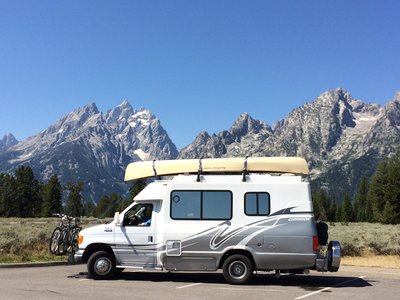
Okay, so I finally took a look at that diagram. Ironically, one reason it took me so long is that my buddy just got a new RV, and so of course it has the "standard" RV charging system, which wasn't working at ALL for the boondocking we're doing, and we're in the process of planning out improvements, ordering parts, etc. But of course we're in the mountains without many tools, etc. Isn't that how it goes?

So, ignoring everything that isn't germane, and writing it down so it clarifies to me as well, you basically have a start (Ford) battery, a house battery, and then a couple of solenoids between them, plus a couple of switches. Exactly how those all work isn't totally important if you are just going to put in a 7622 (which is a great choice, as long as you are happy with bi-directional charging). Not saying you shouldn't be, just that it's a choice* (see more below).
So let's mentally say you remove all the wiring/components that deal with these functions. That looks like it would be the two large cables (4 gauge red from the start battery, 8 gauge red from the house battery, the two solenoids, the two switches and their associated wiring, and the collection of fuses).
I'm not sure how physically far apart your two battery banks are. Are they both under the hood? Long distances in 12 volt DC systems mean you want really chunky wiring (to avoid voltage drop).
Also (you probably told me this but I forget now, sorry!), if you want to self jump start, and you want a safe over-current protected (fuses or breakers) system (a GOOD idea since batteries store a lot of short-circuit power potential (for example, over 10,000 amps for the pair of house batteries my bud is putting in

), then your primary wiring (the big/main positive negative cable circle) needs to be able to be fused high enough to not blow under the starter's current.
So, come to think of it, can you say (or remind me if I have forgotten by now) of the answers to these questions?
1) What is the distance from your start battery to your house battery? In other words, if you ran a hose from one to the other (with all necessary twists and turns), how long would it be? I can probably estimate from the locations, once I know what they are.
2) Do you want to have self-jump start ability? Or only charge combine ability?
3) Do you want bi-directional charging (both sources can charge both banks)?
Ready to respond - it's semi-break time while we wait for some of buddy's components to arrive.
BG
*Bi-directional charging means that when there is a charging source on the start battery (typically alternator when driving), it will be automatically shared with the house bank. And when there is a charging source on the house bank (typically shore power, generator, or solar) it will be shared with the start bank. There are uni-directional relays (not the 7622 and not sure any Blue Sea ACR). That would typically mean that alternator power would go to your house bank, but house charging sources would not go to your start battery.


 ).
).