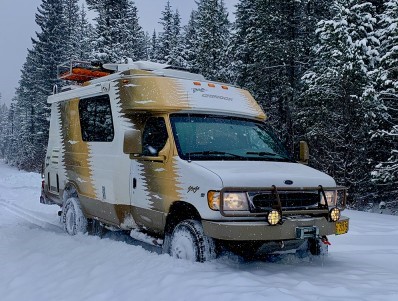
I think David has an excellent point that you should look at. There is a thread somewhere here that someone upgrade their furnace to a more efficient type. There is also heating blanket, but I think they are pretty heavy on the battery, so it probably won't be a good alternative. You can do more than one aspect on this, for example, looking at window shade that help as insulation, more battery, and better furnace, etc. You can do it one at a time, and pick the most economical and efficient one first.
Edit: here is the link: viewtopic.php?f=4&t=1982&p=17890 My reservation on that it cutting hole on the roof, and need to rearrange it since it is not a direct replacement of the stock furnace.
(I assume your solar panels are clean and not covered with dirt, right? Every little bit helps.)
Larger Amp Alternator
Re: Larger Amp Alternator
Last edited by chin_k on December 3rd, 2020, 8:27 pm, edited 1 time in total.
2000 Concourse dinette, on 1999 6.8L Ford E350 Triton V-10 Chassis
Re: Larger Amp Alternator
I believe that without a B2B charger the voltage the batteries receive will not go over 14.4V, which won't give enough 'pressure' to a deep cycle lead acid battery to push a lot of amps through (actually probably less than 14.4V because of wire loss due to distance and gauge). I strongly doubt that your low charging currently is being limited by the alternator's top output, as opposed to just not having a charging cycle/algorithm that can put the voltage high enough for a good bulk charge for deep cycle batteries.68camaro wrote: December 3rd, 2020, 6:25 pm Bob, thanks for all the info and thoughtful response. I definitely do not want to go lithium right now. I wanted to avoid the dual alternator since it seemed more complicated than single.
If I get the larger won't a high idle kit get rpms up high enough to get much more amps to coach battery than at idle? I will look into this further and if juice isn't worth squeeze I will look at dual alternator route.
Thanks
To give an example, when I first bought my concourse I put in 2 new 12V 110AH batteries for the coach, and a few weeks later drove the better part of 2 days on the highway. I can't remember the exact hours needed, but I was surprised to find that the batteries took a long time to reach a full charge from about 65-70% (to completely full according to my Bogart 2025-RV monitor). Much slower than the converter charger with the Wizard took (like maybe 3 times longer or something). Then I read about Battery to Battery chargers and decided to purchase a Sterling 45 Amp model. By adding that, my charging time while driving dropped to better than the converter charger. Same alternator, same batteries, same highway driving. In fact, with those 2 12V 110AH batteries, probably never down below 60% charge, with the B2B it charges in bulk around 20-30 Amps usually (sometimes it starts at 35Amps but usually that doesn't last long before the algorithm drops it to 30 or 25 Amps). So with those 2 batteries there was never a need to have an alternator better than the 130 Amp standard. The charging was limited by the batteries ability to take a charge, rather than the highest amps the B2B or alternator could put out.
I can't recall offhand what the charging was like with the B2B on engine idle, but I think it was at or close to what I got when driving (20-25 Amps usually). Given that pulling all of 40 amps tops from the alternator (charging the batteries at 30 amps) would only be 30% of the alternator's top output, that seems reasonable to me. I don't think it made that much difference, idle or not, though the monitor was in the coach, so I couldn't check it while driving
 . I don't think you would want to try to charge 220AH lead acid at a higher rate even when they are really low.
Do you have a battery monitor, like my 2025-RV? Something that will show you the charging amps and voltage at the coach batteries? If so, have someone watch it while the engine is at idle, and then while you're driving on the highway. See if there is any real difference, taking into account depth of charge during each test. If not, then getting a more powerful alternator, or using a high idle kit, would not make any difference. And I'm betting there isn't.
2000 Concourse, Ford Triton 6.8 V10
Re: Larger Amp Alternator
You hit nail on head, for steelhead it gets dark by 6pm, and temps below freezing, at least overnight. Standing in knee deep 32* water while ice breaks up in morning wakes you up pretty quick.deppstein wrote: December 3rd, 2020, 6:55 pm Since it sounds like your main concern is heat while winter fly fishing, maybe easiest to upgrade your furnace. The original fan in our furnaces is really inefficient and there are much better options out there these days—like Airxcel nt-sq models or propex hs2800.
I will look into the new heater, I actually like my stock heater, it pulls 3.5 amps when on and does great job heating rig. In 20* temp I can set temp at 68* and rig is toasty. However, it is a little loud and 20 years old so if there is a new replacement available that is more quiet and efficient it seems reasonable upgrade.
Chin, I follow Willywilderbeasts rig and was impressed with furnace, but I don't have guts to cut whole in roof...haha. As a matter of fact I will not even put cargo carrier on top due to screw holes. I spend lots of time in crappy weather and I figure more holes = more leaks.chin_k wrote: December 3rd, 2020, 8:21 pm Edit: here is the link: viewtopic.php?f=4&t=1982&p=17890 My reservation on that it cutting hole on the roof, and need to rearrange it since it is not a direct replacement of the stock furnace.
(I assume your solar panels are clean and not covered with dirt, right? Every little bit helps.)
Solar panels probably need cleaning so I will do before I leave Sunday, but lack of sun can be prohibitive factor, plus where I park it. I usually only drive at night, I try to save daytime hours for fishing:)
Bob, I will relook at the B2B charger but without being able to jump start engine batteries with house batteries I am reluctant. My coach batteries are 6v so I can't just transfer one to engine if I was stuck.BobW9 wrote: December 3rd, 2020, 8:26 pm
I believe that without a B2B charger the voltage the batteries receive will not go over 14.4V, which won't give enough 'pressure' to a deep cycle lead acid battery to push a lot of amps through (actually probably less than 14.4V because of wire loss due to distance and gauge).
Do you have a battery monitor, like my 2025-RV? Something that will show you the charging amps and voltage at the coach batteries? If so, have someone watch it while the engine is at idle, and then while you're driving on the highway. See if there is any real difference, taking into account depth of charge during each test. If not, then getting a more powerful alternator, or using a high idle kit, would not make any difference. And I'm betting there isn't.
I do have an upgraded solar/monitor in rig and I can easily tract battery charging usage etc. It was huge improvement for me. Plus I have a scan gauge that I can monitor alternator. I'll check alter. output and and track charging times to help figure out direction.
I just saw that some Lithium batteries have built in heaters to recharge below freezing....this was my biggest reason not to get lithium when I upgraded to 6V. These aren't cheap but charging benefits and charging below 32* make them interesting.
2001 Concourse XL Lounge model, 6.8L Ford E350 Triton V-10 Chassis.
Re: Larger Amp Alternator
I’m going to take a different track here and suggest that you also consider getting a Honda 1000 watt inverter generator. I have one that I use when boondocking to charge our electric bikes. It is very quiet, and compact enough to fit into the back outside storage compartment (same place we store my wife’s fly fishing boots and waders!). It will run for about 6 hours on less than a gallon of gas. AND, when paired with my NOCO Genius 15000 smart charger that clips directly to the battery terminals it gives me a smart charging option. If you got the larger 30000 model, I think you could just about fully charge your house bank during the day while fishing. I have found this to be a better, simpler option for me than going B2B. And the NOCO has a “jump start battery” mode just in case you do get stuck out there.
Tight Lines.
David
Tight Lines.
David
Re: Larger Amp Alternator
There's an idea, I have a 2000i and a Genius G2600 but generator would be too big. I would be concerned about theft since I leave rig for many hours sitting alone. I guess if I went this route I could just use generator after getting to rig and if only on for hour it would be too bad..deppstein wrote: December 4th, 2020, 6:31 am I’m going to take a different track here and suggest that you also consider getting a Honda 1000 watt inverter generator. I have one that I use when boondocking to charge our electric bikes. It is very quiet, and compact enough to fit into the back outside storage compartment (same place we store my wife’s fly fishing boots and waders!). It will run for about 6 hours on less than a gallon of gas. AND, when paired with my NOCO Genius 15000 smart charger that clips directly to the battery terminals it gives me a smart charging option. If you got the larger 30000 model, I think you could just about fully charge your house bank during the day while fishing. I have found this to be a better, simpler option for me than going B2B. And the NOCO has a “jump start battery” mode just in case you do get stuck out there.
Tight Lines.
David
2001 Concourse XL Lounge model, 6.8L Ford E350 Triton V-10 Chassis.
Re: Larger Amp Alternator
If that is the only issue, then I'd suggest just adding a wire that goes around the B2B and a manual bypass switch in case you needed to jump start. Or even just long jump starter cables that you could run from the coach compartment to the engine starter battery if needed.68camaro wrote: December 4th, 2020, 4:43 am Bob, I will relook at the B2B charger but without being able to jump start engine batteries with house batteries I am reluctant. My coach batteries are 6v so I can't just transfer one to engine if I was stuck.
I do have an upgraded solar/monitor in rig and I can easily tract battery charging usage etc. It was huge improvement for me. Plus I have a scan gauge that I can monitor alternator. I'll check alter. output and and track charging times to help figure out direction.
I just saw that some Lithium batteries have built in heaters to recharge below freezing....this was my biggest reason not to get lithium when I upgraded to 6V. These aren't cheap but charging benefits and charging below 32* make them interesting.
Do note the Sterling Power B2B is not that small and wouldn't fit in the engine compartment (and would probably get too hot in there in summer). I had mine in the battery compartment next to the batteries. The model I have uses a fan, so I never put anything else in the compartment except the 2 batteries and the B2B, and that seemed to work fine even in hot summers.
Lithium is great, but personally I'd only do it if moving the batteries inside the coach, where I keep them at the same reasonable temps I like for myself (e.g. even when just driving around in the summer I have the AC on, and heat in the winter). They don't charge below 32, but from what I've read in blogs and technical details they also lose life when being used in hot weather, like perhaps inside small compartments outside the coach. You will also have to either disconnect the alternator charging or buy a B2B or dual alternator, as Lithium requires a different charging algorithm, and make sure it either has a temp sensor on the batteries and knows to stop charging when they are cold, or a manual disconnect for driving when you aren't using the coach (e.g. just driving around, taking it for service in the winter, etc). Same thing goes for the Solar Charger, if your current one has Lithium setting and temp sensor that's great, otherwise you'll need a new one. And the Converter Charger, same thing. Having built-in heaters might be interesting, but remember that they use quite a few amps to do the heating, so you can't have them on 24/7 when not using the RV, and in cold weather camping I think they use something like 6 Amps, which is twice that heater fan we have. So if you're just driving the RV somewhere in winter (not on a trip), you still need to pre-heat the batteries or make sure none of your devices will attempt to charge them when cold, like driving for service or gas. It all is possible, and if you need the power, then Lithium are great - just be sure to figure it all out ahead of time, as costs and complexity can add up incrementally.
Good luck!
2000 Concourse, Ford Triton 6.8 V10
Re: Larger Amp Alternator
Thanks all for all the info, but after spending 4 nights and 5 day trip fishing with night time temps in the 20's, I realized I can easily make do with what I have. Since it gets dark around 5, I rain the generator one night from 5-7 since I was boonedocking in same place for two days. I was in crazy remote spot so no fear of disturbing anyone as crazy as me for being there in the first place.
Also, the limitations of my AGM batteries meant it would be difficult to achieve the results I wanted and any possible solution in my opinion, wasn't worth the effort.
Also, the limitations of my AGM batteries meant it would be difficult to achieve the results I wanted and any possible solution in my opinion, wasn't worth the effort.
2001 Concourse XL Lounge model, 6.8L Ford E350 Triton V-10 Chassis.
Re: Larger Amp Alternator
Sounds reasonable to me. Thanks for the update, and happy fishing!
2000 Concourse, Ford Triton 6.8 V10
Re: Larger Amp Alternator
You have a 45 Amp charger, right? Did you explain why you can't increase your battery reserve by adding two additional 6V AGM batteries?
2000 Concourse dinette, on 1999 6.8L Ford E350 Triton V-10 Chassis
Re: Larger Amp Alternator
Chin, I have thought about it but I would have to take battery tray out and possibly reinforcing floor. If I ever retire and do longer trips then this could be option but nearly all my trips are long weekends so current setup does work, as I often travel far between fishing holes giving batteries time to recharge.chin_k wrote: December 16th, 2020, 4:09 pm You have a 45 Amp charger, right? Did you explain why you can't increase your battery reserve by adding two additional 6V AGM batteries?
2001 Concourse XL Lounge model, 6.8L Ford E350 Triton V-10 Chassis.