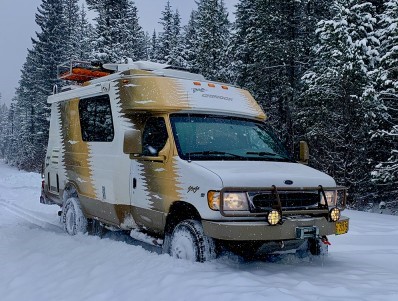
aftermarket rear bumper.
-
markatherton
- Posts: 266
- Joined: December 20th, 2017, 9:09 am
aftermarket rear bumper.
There are a lot of smart people on this site so I thought I would pose this question; I have a 1997 concourse side entry; I am considering adding an aftermarket rear bumper probably from aluminess; The weights I have calculated are as follows; Bumper with twin arms, bike rack and fuel carrier box 185 lbs; 3 five gallon cans of fuel 120 lbs; 2 bikes 100 lbs; spare tire 80 lbs;Total weight 485 lbs; I know there is the physics of adding weight behind the rear axle, so maybe 800 lbs effectively added to the rear of the vehicle? ; Too much? I should mention I am lifting the vehicle for a 4x4 conversion which would have heavier rear springs and fox shocks. What problems could I encounter? Mark in San Diego

Re: aftermarket rear bumper.
I can run a calculation. But I think off the top of my head you'd be looking at adding around 725# to the rear axle. I think that might be hard to accommodate unless you keep your Chinook very light. The only way to know for sure is to take it to a scale and weigh the rear axle (if your fuel tank is not full know that that adds around 250# and it is behind the rear axle, as are the grey and black tanks). I'm less familiar with the side entry but I don't see how it could be any lighter than the rear entry back there (plus there is perhaps more storage under the bed for more weight?).markatherton wrote:There are a lot of smart people on this site so I thought I would pose this question; I have a 1997 concourse side entry; I am considering adding an aftermarket rear bumper probably from aluminess; The weights I have calculated are as follows; Bumper with twin arms, bike rack and fuel carrier box 185 lbs; 3 five gallon cans of fuel 120 lbs; 2 bikes 100 lbs; spare tire 80 lbs;Total weight 485 lbs; I know there is the physics of adding weight behind the rear axle, so maybe 800 lbs effectively added to the rear of the vehicle? ; Too much? I should mention I am lifting the vehicle for a 4x4 conversion which would have heavier rear springs and fox shocks. What problems could I encounter? Mark in San Diego
A 4 x 4 conversion will likely add weight as well (heavier/larger wheels/tires, maybe other suspension or drive parts I don't know about?). It's hard to point to any one thing that makes up the rear axle weight rating (or the gross vehicle weight rating, for that matter). On my buddy's E-450 it was pretty clearly the tires (he had to run them at their max of 80#), but there are so many components (axles, gears, springs, frame, brakes, wheels, tires, connections...). So when it comes to going over the rating, I think it's hard to say what parts you'd need to upgrade.
You may be able to stay under ratings with all that on the back but I think you'll need to keep an eye on things by weighing. I base that on my scale weights (I've weighed a half dozen or more times, with varying loads), with a fairly light coach, traveling solo, and adding 550# effective to the rear axle with my largest trailer.
Another option would be to tow a small cargo trailer: Then you can easily carry everything because much of the weight will be on the trailer axle vs. all being on the tongue (or like on the tongue since it's on the rear bumper). Also it will all be secure, dry, and clean. That might not be ideal if you are going off-road with a 4x4 conversion, but then the whole coach has other issues with doing that anyway (at least IMO).
Anyway, if it were me I'd start by loading up with food/water/clothing/supplies/people/fuel and heading to the scale, then - if you like - come back here and post your weights.
Basically, the E-350 chassis doesn't have a huge amount of leeway on the weights - especially on the rear axle. Which is still fine usually as, being small, you can only cram so much in anyway. But adding stuff to the outside changes that equation.
Also, of course nothing instantly breaks if you go over ratings; there is some safety margin engineered in. But I wouldn't be comfortable designing to be overweight. I'm curious how a side entry weighs out compared to a rear entry. You do have the refrigerator a little bit further forward, but I'm not sure what's under the bed. Bathroom side seems like it would be a wash vs. the rear entry. And I think you have smaller capacity freshwater and propane tanks, so there is a little bit saved as well (fresh water tank is outside on side entry, at least according to spec; and propane tank is smaller having something to do with its placement near the door).
1999 Concourse
-
markatherton
- Posts: 266
- Joined: December 20th, 2017, 9:09 am
Re: aftermarket rear bumper.
I am already thinking of cutting down to one 5 gallon gas can; I can also save some by buying al Alcoa aluminum wheel for the spare tire;
Re: aftermarket rear bumper.
That might not be a great thing, unless something has changed (or maybe you have a plan already). Reason I say that is that even when you run "all" Alcoa wheels, you generally keep steelies on the rear inner duals. And so then a steel spare. Reason is that two aluminum wheels won't fit on the lugs together (too thick). Meaning that you can use a steely spare for any position, but an aluminum spare only for the front or outer rear positions.markatherton wrote:I can also save some by buying al Alcoa aluminum wheel for the spare tire;
I think you can maybe get some longer studs or extenders (but of course you'd want to make sure they are strong enough, will clear fenders, etc).
I've mentioned this before, but I run my (steel) spare on a front hitch mount. That not only removed the weight of the spare and bracket from the rear (where it was hanging way out there), but moved it to the front (which takes more weight off the rear). I can't remember the figures exactly, but I want to say it shifted close to 200# off the rear axle (don't quote me on that though as I did the calcs four years ago when I moved it forward).
1999 Concourse
-
markatherton
- Posts: 266
- Joined: December 20th, 2017, 9:09 am
Re: aftermarket rear bumper.
Let me rethink this; bumper 185 lbs; i gas can 40 lbs; bikes 100 lbs; don't have to add spare tire cuz its already on there. so net increase is 325 lbs plus the physics effect. i think this is doable...
Re: aftermarket rear bumper.
325# will come out to just about 550# on the rear axle (I know that one by heart because my trailer tongue weight is very close to that).
I can still come in under the axle weight rating although sometimes it's close. Just for comparison's sake, here are some rear axle weights for my Concourse. BTW my GAWR-R is 7,500#. I think some years may have been different. These are all with me traveling solo.
1) On the way home from buying Chinook which was bone stock; I did have some possessions with me though
6880#
2) Later in the year, after having removed a number of things (Air-con, furnace, etc.), but also having moved in all my stuff and tools, and with a full fuel tank. Spare on front. No trailer:
6950#
3) Extra interior stuff still gone, but added around 150# of battery over stock weight, and towing trailer with 330# of tongue weight. Spare on front still. No water, black, grey to speak of. Refrigerator empty. Maybe 1/2 full propane tank (didn't note).
7300#
4) More stuff gone (oak cabinetry, refrigerator), and towing a cargo trailer with around 200# of tongue weight. No water, grey, black, or propane to speak of. 1/3 tank fuel:
6850#
It's #3 that gives me pause for adding a lot of "permanent" weight to the rear, especially if one travels with others (I'm usually solo), and/or loads up the mod cons (full water heater, big fridge, clothing and food for two, etc., which I don't carry). Because there I'm within 200# of being overweight on the rear axle. Also, at that same time, I was within 300# of being over the GVWR altogether. These are the ratings for my 1999 Concourse:
GAWR-F = 3700
GAWR-R = 7500
GVWR = 10,700
In #3 above, I was at 10,400# total between the front and rear axles. Was within 200# of the rear axle rating, and had 600# left on front axle, but still was only 300# below the GCWR. This is what makes the 18,000# GCWR completely unrealistic for an RV. Sure, maybe if you had a bare cab/chassis. But here I was at Gross Combined of 12,400# and almost up to ratings on the vehicle itself. Not likely to be able to add nearly 6,000# more of trailer!
But still, I think each Chinook is going to be a little bit different (options) and plus who really knows how much clothing and food and "stuff" is normal between two different travelers? So who knows, maybe you'll be at 6500# and have all the room in the world under ratings. So I think the only real way to know is to weigh yourself, making notes about what is full and empty, what you have onboard for gear, etc.
There are probably better candidates for "loading up" (like say a Class C on the smaller end of the size scale but on the E-450 chassis), but as long as you can stay under ratings you're golden, and the Chinook is a nice handy size for sure.
I can still come in under the axle weight rating although sometimes it's close. Just for comparison's sake, here are some rear axle weights for my Concourse. BTW my GAWR-R is 7,500#. I think some years may have been different. These are all with me traveling solo.
1) On the way home from buying Chinook which was bone stock; I did have some possessions with me though
6880#
2) Later in the year, after having removed a number of things (Air-con, furnace, etc.), but also having moved in all my stuff and tools, and with a full fuel tank. Spare on front. No trailer:
6950#
3) Extra interior stuff still gone, but added around 150# of battery over stock weight, and towing trailer with 330# of tongue weight. Spare on front still. No water, black, grey to speak of. Refrigerator empty. Maybe 1/2 full propane tank (didn't note).
7300#
4) More stuff gone (oak cabinetry, refrigerator), and towing a cargo trailer with around 200# of tongue weight. No water, grey, black, or propane to speak of. 1/3 tank fuel:
6850#
It's #3 that gives me pause for adding a lot of "permanent" weight to the rear, especially if one travels with others (I'm usually solo), and/or loads up the mod cons (full water heater, big fridge, clothing and food for two, etc., which I don't carry). Because there I'm within 200# of being overweight on the rear axle. Also, at that same time, I was within 300# of being over the GVWR altogether. These are the ratings for my 1999 Concourse:
GAWR-F = 3700
GAWR-R = 7500
GVWR = 10,700
In #3 above, I was at 10,400# total between the front and rear axles. Was within 200# of the rear axle rating, and had 600# left on front axle, but still was only 300# below the GCWR. This is what makes the 18,000# GCWR completely unrealistic for an RV. Sure, maybe if you had a bare cab/chassis. But here I was at Gross Combined of 12,400# and almost up to ratings on the vehicle itself. Not likely to be able to add nearly 6,000# more of trailer!
But still, I think each Chinook is going to be a little bit different (options) and plus who really knows how much clothing and food and "stuff" is normal between two different travelers? So who knows, maybe you'll be at 6500# and have all the room in the world under ratings. So I think the only real way to know is to weigh yourself, making notes about what is full and empty, what you have onboard for gear, etc.
There are probably better candidates for "loading up" (like say a Class C on the smaller end of the size scale but on the E-450 chassis), but as long as you can stay under ratings you're golden, and the Chinook is a nice handy size for sure.
1999 Concourse
-
Chinnin-about
- Posts: 214
- Joined: November 27th, 2017, 6:07 pm
Re: aftermarket rear bumper.
Since you're converting to 4x4 for off road, you might as well upgrade the rear axle to e-450 or two ton. I wouldn't want to be near max weight off road, and Chinooks are already only about 1000 lbs from max weight before you load any gear, fuel or bodies. I was at 9300 with myself and a tank of gas, no water or food, etc. My Chinook tops out at 10.5
-
markatherton
- Posts: 266
- Joined: December 20th, 2017, 9:09 am
Re: aftermarket rear bumper.
I have seen dana 70's in some older ford e350's. Would that do it or do i need to go up to the f450 f550 axle (10 lug)?
Re: aftermarket rear bumper.
One thing to note is that the E-450 axle (track) is wider than the E-350. I imagine there are other differences as well, but that one comes to mind right off the bat.
1999 Concourse

Re: aftermarket rear bumper.
You should have a Dana 70 already, which is a full floater and a beast. There's usually a metal tag on the diff cover stating the model, and your axle should be referenced in the VIN tag by the driver door.markatherton wrote:I have seen dana 70's in some older ford e350's. Would that do it or do i need to go up to the f450 f550 axle (10 lug)?
1994 Premier