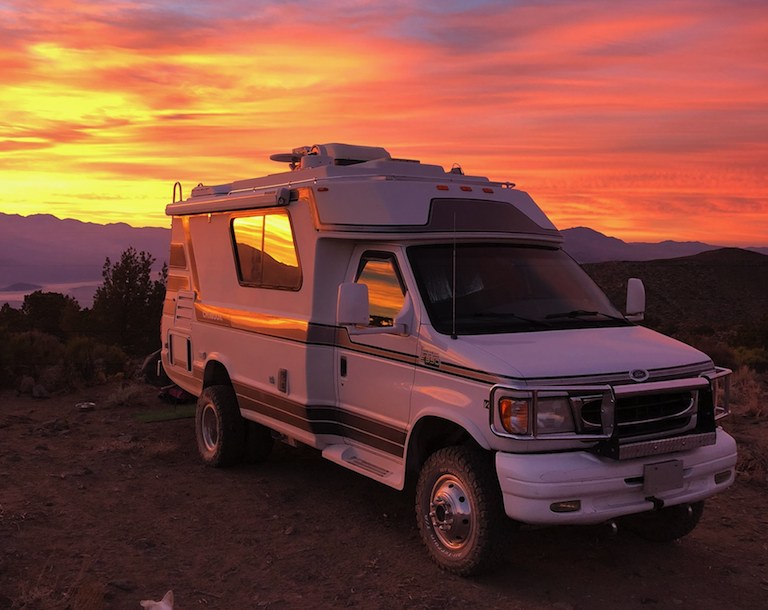

I agree that roadside assistance is good and I carry a policy. But, they usually won't go off of paved roads, and I spend a lot of time camping off of paved roads (not actual "four wheeling," but more gravel/BLM/Forest Service type stuff. So, I assembled a kit that would allow me to change a tire, preferably with help from another person, but I can do it all myself if necessary except for getting the "bad" tire back up onto my spare holder (if I had to, I'd leave it and try to go back).
As a side bonus, I can remove my tires one by one and bring them in for tire work. Now, if I had a trusted tire shop at my disposal at all times, I might not. But, I don't, and so having them mess with my rig PLUS do the tires is sometimes just not a good scene. My stress level went down by a good few notches when just brought the wheel/tire in (in the back of a friend's car). Plus it's good practice with my kit.
What I have is the stock jack (but I've used a friend's hydraulic cylinder jack and it's easier), a long breaker bar, and a torque wrench. Added to that is a little orange kit of sockets and extenders that fit the Chinook lug nuts plus those on my trailer (it has various sockets). You need a socket extension to get into the duallies. I kept the original Ford crowbar type bar because it's perfect for putting under the tire and gently levering it up onto the lugs. I have the Lynx leveler blocks I use for camping, plus a pair of rubber wheel chocks for various purposes, plus a couple of hunks of wood. I'd like to add a small Viair type compressor.
While you probably could (?) limp with one of the rear duallies on the front (all of the wheels are dually wheels so they work in all six positions), I'd try not to, because I'm not sure I could trust the "good" rear tire that took all the weight on the way when it was a "singly" on the rear. Of course depending on the situation, other things may take priority over not damaging a tire. Oh, I just thought of something though. Would the lugs be threaded deeply enough to tighten just one wheel onto the rear axle? I'm not sure about that. One certainly could check.
For many years Born Free RV's (also on E-350/E-450 chassis) came without spare tires. I'd be a bit leery if I went off pavement or out in the boonies on-pavement - but not everyone does that. Or maybe some folks travel in a group and could share. On pavement/in civilization I could see it as a calculated risk, because tires are pretty good these days and cell service is good in populated places.
Class A's also often don't have spares, but then probably they assume you're not going
"off roading" for the most part (some do of course). Just be glad we're not buying a set of those tires! I think they can easily run $5-$6k vs. our $1500 or so.
Spare tire relocation
Re: Spare tire relocation
1999 Concourse

Re: Spare tire relocation
Speaking of breaker bars (I had to use one just to get my spare off, which had been put on with an air gun, so I could work on the tire holder), I'm about to get a torque multiplier lug wrench so there will be no need to use swear words trying to get lug nuts off if there's no assistance available.
They use gears to multiply force applied, so that anybody can safely and easily remove tight lug nuts.
Anybody recommend a particular model? I've seen them up to $200. Walmart sells one for under $45, although it's likely junk at that price.
Here's a link to an explanatory page for one of the more heavily advertised ones.
and a typical youtube video ad for one
motorhome specific example video
They use gears to multiply force applied, so that anybody can safely and easily remove tight lug nuts.
Anybody recommend a particular model? I've seen them up to $200. Walmart sells one for under $45, although it's likely junk at that price.
Here's a link to an explanatory page for one of the more heavily advertised ones.
and a typical youtube video ad for one
motorhome specific example video
1994 Concourse dinette, Ford 7.5L (460 V8)
-
Willywalderbeast
- Posts: 232
- Joined: July 17th, 2016, 5:00 pm
Re: Spare tire relocation
Kdarling, check this out. Small compact and removes lugs with ease. http://forresttoolco.com/safety_impact_wrench.html
Re: Spare tire relocation
That's one reason I like to tighten the lug nuts myself (with my own torque wrench). Oftentimes places will tighten them to ridiculous torques. So aggravating. Even a "reasonable" breaker bar (mine is 18" long - just a mechanical bar) will work fine on the specified torque. My torque wrench is only for tightening, hence the separate breaker bar. The BB is sort of like a socket wrench (takes sockets on the end), but no ratchet. You just swivel it 180º to keep going. Not sure if that's universal, or if people mean different things with the term breaker bar.
1999 Concourse

Re: Spare tire relocation
Exactly. I think it's universal. A breaker bar is so called because it's intended to "break loose" heavily torqued nuts or screws. They're long and heavily constructed, and do not have the relatively delicate racheting assembly of a, well, rachet. They're usually inexpensive, and can be "safely" leveraged with a pipe extension (poor man's torque multiplier). I break the lug nuts loose with a breaker, then jack it up, then remove them the rest of the way with a drill. Then for reinstallation, it's the opposite procedure. I don't torque lug nuts. I make sure the threads are clean, then I just work my way around in a two-stage star pattern with a good amount of oompf; I guess "feel" is the word. Use your foot if you have to. There's just too many secondary sources of friction to get a truly accurate torque setting, but that's probably me justifying my laziness. If I'm repeating anything that's already been said, hopefully you can ignore my prattle...
A long breaker bar (2 ft or so), an impact-specific socket & extension, a 3 ton bottle jack, and chocks should always be aboard every rig, I feel. That's even if you never intend to remove a 75 pound wheel/tire yourself; at least someone else can help you by using your gear if necessary. Roadside assistance is a great deal and we all should have it, especially if you like to run out of gas . The problem with that, however, is I'm often in areas without phone reception. To answer M Spec's question more directly, I think you can limp briefly on one rear tire depending on your rig's weight. Whether you "can" or "should" are separate questions. Determine your rear axle weight, and compare it to the load capacity of your tires. Then assess your risk (and your personal tolerance in a worst case scenario). Aside from all that, the first thing I would do is make sure that it's really easy to check your tire pressures; the easier it is, the more likely you'll do it. In the rear, I use the "inflate through caps" (the good German ones) and a good gauge with a dual angle chuck. It's a five minute job, and no need for braided hoses. 12V compressors are cheap, so you should have one of those as well. Know the age of your tires, look for cracks or irregular wear patterns, and exercise them regularly. Tires have a chemical makeup that likes the slight, consistent deformation caused by driving; extended sitting is a no no. Tires are expensive and vitally important, and often neglected. And there's no point in carrying a spare if it's not properly inflated or in poor condition. If you're motivated, tire plug kits are compact, cheap, and can get you out of a bind in some cases, so I carry a couple of those, too. They're not terribly difficult to install, but they're only really useful for nails. If you want to go off the nerd's deep end, you can use a temp gun to check temperature after extended runs. If I'm babbling on about stuff you already know, my apologies!!
A long breaker bar (2 ft or so), an impact-specific socket & extension, a 3 ton bottle jack, and chocks should always be aboard every rig, I feel. That's even if you never intend to remove a 75 pound wheel/tire yourself; at least someone else can help you by using your gear if necessary. Roadside assistance is a great deal and we all should have it, especially if you like to run out of gas
. The problem with that, however, is I'm often in areas without phone reception. To answer M Spec's question more directly, I think you can limp briefly on one rear tire depending on your rig's weight. Whether you "can" or "should" are separate questions. Determine your rear axle weight, and compare it to the load capacity of your tires. Then assess your risk (and your personal tolerance in a worst case scenario). Aside from all that, the first thing I would do is make sure that it's really easy to check your tire pressures; the easier it is, the more likely you'll do it. In the rear, I use the "inflate through caps" (the good German ones) and a good gauge with a dual angle chuck. It's a five minute job, and no need for braided hoses. 12V compressors are cheap, so you should have one of those as well. Know the age of your tires, look for cracks or irregular wear patterns, and exercise them regularly. Tires have a chemical makeup that likes the slight, consistent deformation caused by driving; extended sitting is a no no. Tires are expensive and vitally important, and often neglected. And there's no point in carrying a spare if it's not properly inflated or in poor condition. If you're motivated, tire plug kits are compact, cheap, and can get you out of a bind in some cases, so I carry a couple of those, too. They're not terribly difficult to install, but they're only really useful for nails. If you want to go off the nerd's deep end, you can use a temp gun to check temperature after extended runs. If I'm babbling on about stuff you already know, my apologies!!1994 Premier