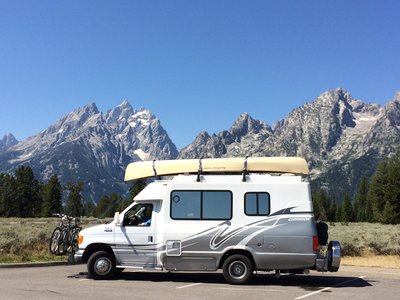
I love this forum! Having the likes of Blue-Go, Kdarling, scott, A Rooney is like having my very own fantastic Tech Support! Thanks guys. The wealth of information is staggering, and the depth of knowledge is impressive indeed. And, tailored to Chinooks...can't get much better than that.
So, I have no read (and re-read) all of these related posts, and they have given me much to contemplate. My thinking about how best to solve my issue of charging my two Copenhagen Wheels while on the road, and when boon docking for a couple of days (as is our regular pattern of use) continues to evolve and unfold--largely as a result of what you all have had to offer by way of advice and counsel.
To augment what I have learned here, I went back to Superpedestrian (makers of the Copenhagen Wheel) to make sure I had the right specs for charging. The only change/clarification from them was that I should not use the 115 watt input spec for determining load, but rather the 165VA (something having to do with the way the Wheel Charger/Transformer works). So the DC amp need from the House Battery Bank is more like 30 amps (inclusive of amps to power the inverter)/330 watts total for both chargers. Based on that, here is where I am at (for now):
Charging while on the road: I have decided to scale down the Pure Sine Inverter from 1000 watts to 600 watts. Based on information provided by you all, I am comfortable with my 150 amp alternator to handle this degree of demand, with some still left to go to keeping the House Bank charged. And, if I do notice any evidence of overheating, I can always move to charging one wheel at a time (half the load)...It takes 4 hours to get a full charge on the Wheel, BUT, a 2 hour charge will bring it to 80%--I can live with that. To improve my odds, I will indeed move to replace my stock 4awg charging wire to a 1/0, locate the inverter close to the battery bank and run solid heavy gauge 6awg at a minimum. All in favor???
Charging while boon docking: When we have the luxury of a nice site with shore power, no problem--simply plug Wheel chargers into shore power post...not need to do anything on the Rig side of things. As to when we are really boon docking...that, as they say, is the crux of the issue.
As you know, the first idea I had was to get a Goal Zero Yeti solar charger...yes, that box built primarily for weekenders who want to get away...NOT. My thinking about this was akin to the sentiments expressed about having a Rig electrical system that, while not perfect, meets our current and anticipated use scenarios pretty well. The new Yeti 1000 Lithium Ion model (due out mid-March) comes closest to fitting the bill when paired with a portable solar array. Enough juice to charge my wheels at night for 2 hours, and then run the power back in during the day with 200 watts of solar. Issues with that: Not really enough power back in during the day with 200 amps of solar to be ready for another 2 hours of charging that night (as needed if we happened to be riding bikes each day); AND, the unit itself costs $1000, and then another $500 or so for everything needed for the portable solar...more like $800+ if I went with the high-end foldable Zamp 200 mono system. So, that option has been set aside...for now.
Putting the Yeti into the "parking lot" brought me back to trying to figure out if I could somehow use the existing Rig system of 220 ah House Bank to charge up the wheels while stationary. And, here is my latest thinking on this--based on all the good input (including things like the Peukert effect):
Charging my wheels at night for 2 hours at the campsite would draw approximately 78 amps (15 amps each x 2= 60 amps x 1.3 for Peukert effect)=78 amps. Using the rule of not drawing down more than 40% (88amps) of the total available battery load, I could theoretically just sneak by--assuming I kept other Rig loads to a minimum (battery lantern instead of lights, frig on propane, forego hot water on nights wheel needs to be charged, minimal, if any water pump use, etc.). Not ideal, but worth a try...worst comes to happen, my two Group 31's succumb and I have learned a valuable lesson.
If it does work, then there I am in the woods in the morning, with bikes 80% charged, and my House Bank hovering near disconnect. At which time, I figure, it is time to break out the portable solar 200 watt system, hook it up to the House Bank and let it go to work re-charging the House Bank. Looking at input specs from units like the Zamp 200 watt system, it looks like it would take me about 6-7 hours of charging to get the batteries back up to close--able to be finished off with a quick run of the inboard generator if need-be. Then for the following nights and days...draw and repeat.
I understand that this is treading on thin ice, and I could fall in. But, if I can make it work, it would be the easiest way to accomplish my goals...and, if not, I have lost a couple of batteries...and go back to working out a better way--like enlarging my House Bank capacity, adding more solar...???
I look forward to hearing all your thoughts.
David
Hooking Inverter to House Batteries to charge while driving

Re: Hooking Inverter to House Batteries to charge while driv
I looked at the Copenhagen site and couldn't find a 12VDC charging option, which would be ideal during boondocking. Bummer. There really should be. I'd call them and whine a little. Sorry if I'm reiterating anything that's already been posted... Your engine turns an alternator, with very little relative loss of efficiency (fuel), which produces an alternating current which goes through a rectifier and voltage regulator and becomes a 12ish volt direct current. Then, in powering an inverter to get 110VAC, there is an inherent energy loss in that conversion; heat mostly. Now you're plugging in an AC powered charger which converts back to lower voltage DC for the lipo cells in the wheel; I think 48V or so? More heat. There's efficiency loss in there for sure, but if you're only charging while on the road, who cares; that V10 is a turning anyway, and the wheel's charger is very likely to be smart. Gravy. Cooking your alternator (or taxing your batteries while parked) is probably unlikely, but if you're willing to tolerate that risk in the name of experimentation, then bravo! I encourage that, even if your accountant doesn't. Your inverter should be as close to your bank as practical since voltage drop (power wasted) across a line is inversely proportional to voltage. This is why grid power distribution is always at very high voltage. Your AC lines can be much longer with negligible loss. As far as the fridge goes, I'd advise just running it on propane; that's the priority design parameter of the absorption process. Three way fridge is almost like saying solar generator. Bigger wire is better to avoid loss, but there is a point of diminished return. Anaconda cable can be unwieldy and costly. No reason to go bigger than needed. Welding cable is supple, whereas marine duplex is convenient. Distance and current are easy to determine. Add a bit of a safety margin, fuse everything at both ends ideally, and call it a day. I have nothing against lipo battery banks, and I hope to have one some day, but the price as of February 2017 is still prohibitive. Solar generators lol are nice for those who want a plug and play, portable solution. But separate components which have been long proven win with me for reliability, component compatibility, and cost. But I'm a 6V flooded-cell holdout; friends call me a laggard. I'm only talking about house banks here btw; phones, electric bicycles, etc., there's no other way than lipo, obviously. For the Zamp, 6 or 7 hours per day might be optimistic and might put you in peril on most days outside of August. I.e. depending on weather, latitude, and season, you might not make it, and being dependant on that might get annoying. And running the genset? Ah, that's for those who like noise and exhaust. Match your amp hours with your solar watts, run your fridge on propane, charge your bikes as best you can with a 1k inverter (yes 600 will be marginally more efficient (if at all), but you might like the headroom of the 1000w), and try not to let your bank get below 50%. Then go have fun!
1994 Premier

Re: Hooking Inverter to House Batteries to charge while driv
I think it's really cool how - when faced with a topic that can easily boggle, and requires a certain slow swimming toward the surface to understand the ins and outs - you dive in and swim!
There's lots to potentially comment on (and Scott's reply did that), but just one specific comment (while I watch out the window for a friend to come by):
I'd posit that charging most of the day via solar panels, then "finishing off" with the generator is probably the reverse of what you want to do. Here is why, and it's one of the "bugaboos" of lead acid batteries. Basically you have two charging stages. The first one is "bulk," and for our purposes we can throw everything we have at the batteries and they will swallow it. That is, until they get to about 85% charged. Then beings the slow slog known as the "absorption" (aka "acceptance") stage. At this stage you are basically shoving the charging power through the eye of a needle, and as you can imagine, that's slow. Painfully slow. This painfully slow stage goes all the way until they get to 100%. After that you have the third stage (float), but it's basically a maintenance stage, so that's why I said we really only care about the two main stages in this paragraph.
So, you have the generator (and to a lesser extent, the alternator), which can throw up to 50 amps (or whatever size your charger is, presuming you are not throwing it all away in voltage drop ( ). And then you have the solar panels, which in comparison are only capable of dribbling in maybe 10 amps even in their best moment (we're talking 200 watts, perfectly set up here), and 6 amps or so in lesser moments. So using the solar panels to get up to 80%, and then the generator to finish off is sort of backwards, given what we have to work with (length of day, size of solar array, etc.).
If you do it in reverse, you can throw in 50 amps or so in the bulk stage rather quickly with the charger, then let the comparatively slow solar panels push the last 15% through the eye of the needle. That matches their capabilities better, IMO.
Two examples. Let's say you run your batteries right down to 50%, so you are down 100 amps in the morning. In example "A," you use the solar panels much of the day, then top up with the generator when they quit working. We'll give you a nice sunny day in the fall, tilted panels, an MPPT controller, the works (BTW this is just about my scenario, except I'm typically only down around 50 amp hours in the morning, and I do all my re-charging by 200 watts of solar). At 100 amps down, you have around 70 amps to put in before you get to the absorption stage. The last 25 or so will be absorption.
At this stage of depletion, the batteries will take all they can get. But the panels will probably only give you around 7-9 amps or so, if tilted (or if July) (maybe more if you have MPPT controller, but not tons more). The sun may not clear the ridge until 9 a.m., so by 5 p.m. (presuming no clouds) you will have taken in at best 64 amp hours (and in reality, probably less).
So now it's the golden hour (ahhh) and you fire up the generator (less than ahhhh). You have maybe 30 amp hours to put in. BUT, you are now in the absorption stage. In this stage voltage is held constant (at around 14.3 or so), and amps slowly (sloooowly) taper down. When they are fully charged you should be taking in around 1 amp or so. So this means you'd be running the generator for around 6 hours or more. (I'd be insane by then.) Right through the golden hour, dinner, and into the early nighttime.
Okay, let's try running the generator FIRST. Say you can stand to listen to it for just two hours. You wait until everyone is up, then run it from say, 10 a.m to noon. With a 45 amp charger, you may not even have to run it for two hours to get through the bulk stage. But let's round up and say that at noon you have reached 85% charge and entered the absorption stage. You can shut off the infernal machine! Now the solar panels take over, and you have five hours (or more in summer) to continue the charging. In absorption, they will be taking in fewer and fewer amps, but you will probably get through the absorption stage by sundown (if at any point you have extra solar power - say later in the absorption stage or after you reach float stage, then you can charge things or etc. - that's what I call "free power!" Because if you don't use it, it just never comes in at all (just stays "in the panels" since they will only provide what is asked for.
I typed this up fairly quickly, so every bit of math and every detail was not vetted, but the concept should hold. In a nutshell, the generator is better at fast bulk charge (if you have to use it to make up a big deficit), and the solar panels will shine during the absorption stage.
OTOH, I can fairly easily make up a 50 amp hour deficit over a day on 200 watts of solar alone (more in summer). So there's always that possibility. But if you have to run the generator, I'd do it in the morning for the bulk stage.
There's lots to potentially comment on (and Scott's reply did that), but just one specific comment (while I watch out the window for a friend to come by):
I'd posit that charging most of the day via solar panels, then "finishing off" with the generator is probably the reverse of what you want to do. Here is why, and it's one of the "bugaboos" of lead acid batteries. Basically you have two charging stages. The first one is "bulk," and for our purposes we can throw everything we have at the batteries and they will swallow it. That is, until they get to about 85% charged. Then beings the slow slog known as the "absorption" (aka "acceptance") stage. At this stage you are basically shoving the charging power through the eye of a needle, and as you can imagine, that's slow. Painfully slow. This painfully slow stage goes all the way until they get to 100%. After that you have the third stage (float), but it's basically a maintenance stage, so that's why I said we really only care about the two main stages in this paragraph.
So, you have the generator (and to a lesser extent, the alternator), which can throw up to 50 amps (or whatever size your charger is, presuming you are not throwing it all away in voltage drop (
). And then you have the solar panels, which in comparison are only capable of dribbling in maybe 10 amps even in their best moment (we're talking 200 watts, perfectly set up here), and 6 amps or so in lesser moments. So using the solar panels to get up to 80%, and then the generator to finish off is sort of backwards, given what we have to work with (length of day, size of solar array, etc.).If you do it in reverse, you can throw in 50 amps or so in the bulk stage rather quickly with the charger, then let the comparatively slow solar panels push the last 15% through the eye of the needle. That matches their capabilities better, IMO.
Two examples. Let's say you run your batteries right down to 50%, so you are down 100 amps in the morning. In example "A," you use the solar panels much of the day, then top up with the generator when they quit working. We'll give you a nice sunny day in the fall, tilted panels, an MPPT controller, the works (BTW this is just about my scenario, except I'm typically only down around 50 amp hours in the morning, and I do all my re-charging by 200 watts of solar). At 100 amps down, you have around 70 amps to put in before you get to the absorption stage. The last 25 or so will be absorption.
At this stage of depletion, the batteries will take all they can get. But the panels will probably only give you around 7-9 amps or so, if tilted (or if July) (maybe more if you have MPPT controller, but not tons more). The sun may not clear the ridge until 9 a.m., so by 5 p.m. (presuming no clouds) you will have taken in at best 64 amp hours (and in reality, probably less).
So now it's the golden hour (ahhh) and you fire up the generator (less than ahhhh). You have maybe 30 amp hours to put in. BUT, you are now in the absorption stage. In this stage voltage is held constant (at around 14.3 or so), and amps slowly (sloooowly) taper down. When they are fully charged you should be taking in around 1 amp or so. So this means you'd be running the generator for around 6 hours or more. (I'd be insane by then.) Right through the golden hour, dinner, and into the early nighttime.
Okay, let's try running the generator FIRST. Say you can stand to listen to it for just two hours. You wait until everyone is up, then run it from say, 10 a.m to noon. With a 45 amp charger, you may not even have to run it for two hours to get through the bulk stage. But let's round up and say that at noon you have reached 85% charge and entered the absorption stage. You can shut off the infernal machine! Now the solar panels take over, and you have five hours (or more in summer) to continue the charging. In absorption, they will be taking in fewer and fewer amps, but you will probably get through the absorption stage by sundown (if at any point you have extra solar power - say later in the absorption stage or after you reach float stage, then you can charge things or etc. - that's what I call "free power!" Because if you don't use it, it just never comes in at all (just stays "in the panels" since they will only provide what is asked for.
I typed this up fairly quickly, so every bit of math and every detail was not vetted, but the concept should hold. In a nutshell, the generator is better at fast bulk charge (if you have to use it to make up a big deficit), and the solar panels will shine during the absorption stage.
OTOH, I can fairly easily make up a 50 amp hour deficit over a day on 200 watts of solar alone (more in summer). So there's always that possibility. But if you have to run the generator, I'd do it in the morning for the bulk stage.
1999 Concourse
Re: Hooking Inverter to House Batteries to charge while driv
I share the same alma mater as old Rod Serling,so it's no surprise I occasionally find I have slipped into "the twilight zone"....I AGREE with the points in Scotts summation,as well as Blue go's on battery logistics.Besides there is something wrong with running a large powerful generator burning lots of gas,creating lots noxious fumes,and an abundance of noise (there is no other word to use in association with the Onan) to top off a lead acid battery.....Just so you can power an amazingly high tech environmentally friendly device like the Copenhagen wheel. Rooney
2001 Premier
2001 Premier
Re: Hooking Inverter to House Batteries to charge while driv
I wake up to more terrific comments and suggestions--thanks!
Scott--I too wish that Superpedestrian had a DC charger...and yes, am pushing that with them as a current user. I have even taken my Rig over to their shop in Cambridge to show them how some people plan on using the Wheel. They got excited enough to put me on a Beta List for expedited delivery of my wheel...SO, maybe, sometime in the not too distant future this will be an option. By the way, your calculation on the voltage into the wheel from the charger was right on: 54.6!
Blue-Go...I think you are absolutely right. I was approaching this ass-backwards (as my father used to say). If, after experimentation, it turns out that I need to run the genset, I will do it BEFORE solar.
Some of the other ways I have been thinking about tackling this boon docking charge issue is to do one Wheel at a time (thus half the draw). Maybe even start charging a wheel in the earliesh AM with the solar hooked up--taking in some amps at least while I draw down 15 amps (one wheel). Do this for a couple of hours for each bike at a time...then take a ride in the afternoon while solar continues to plug away. Seems like there are several methods and scenarios to try here with the basic equipment now taking shape:
--Group 31 House Bank with 210 AH capacity
--Heavy Duty Alternator (existing)
--600 watt pure sine inverter with close run to battery
--200 watts of solar with a 15 amp smart charger
Come On Spring!
David
Scott--I too wish that Superpedestrian had a DC charger...and yes, am pushing that with them as a current user. I have even taken my Rig over to their shop in Cambridge to show them how some people plan on using the Wheel. They got excited enough to put me on a Beta List for expedited delivery of my wheel...SO, maybe, sometime in the not too distant future this will be an option. By the way, your calculation on the voltage into the wheel from the charger was right on: 54.6!
Blue-Go...I think you are absolutely right. I was approaching this ass-backwards (as my father used to say). If, after experimentation, it turns out that I need to run the genset, I will do it BEFORE solar.
Some of the other ways I have been thinking about tackling this boon docking charge issue is to do one Wheel at a time (thus half the draw). Maybe even start charging a wheel in the earliesh AM with the solar hooked up--taking in some amps at least while I draw down 15 amps (one wheel). Do this for a couple of hours for each bike at a time...then take a ride in the afternoon while solar continues to plug away. Seems like there are several methods and scenarios to try here with the basic equipment now taking shape:
--Group 31 House Bank with 210 AH capacity
--Heavy Duty Alternator (existing)
--600 watt pure sine inverter with close run to battery
--200 watts of solar with a 15 amp smart charger
Come On Spring!
David
Re: Hooking Inverter to House Batteries to charge while driv
algorithms,
Rooney suggestion to follow: Anyone seriously making a demand of their battery bank,IMO
Should consider a sophisticated Battery Monitor,They give you more accurate information to use,than the idiot lights and LVD,...There are a number of good ones employing different strategies,(Blue at one time posted his favorite)I use the trimetic which by routing all currents thru a Shunt,can count amps going into and out of a battery bank,To calculate full,you program the absorption voltage of your battery and when the amps in/time drops to certain level...it considers your battery full in addition (for some reason maybe Scott or Blue knows) battery manufacturers specify that not only should you replace the amps drawn from your batteries but a certain percentage of charge over that.So again the trimetric uses both these strategies.Its great for knowing what's going on,but once you know and balance your needs,to your capacity,it's less critical....of course if you are making deep DC demands,it's also nice,because the depth of discharge/amount of cycles/effects battery life.So while lead acid battery banks are time tested and reliable,to get optimize longevity,many of us find it helps to maintain and monitor batteries on a regular basis.
Rooney suggestion to follow: Anyone seriously making a demand of their battery bank,IMO
Should consider a sophisticated Battery Monitor,They give you more accurate information to use,than the idiot lights and LVD,...There are a number of good ones employing different strategies,(Blue at one time posted his favorite)I use the trimetic which by routing all currents thru a Shunt,can count amps going into and out of a battery bank,To calculate full,you program the absorption voltage of your battery and when the amps in/time drops to certain level...it considers your battery full in addition (for some reason maybe Scott or Blue knows) battery manufacturers specify that not only should you replace the amps drawn from your batteries but a certain percentage of charge over that.So again the trimetric uses both these strategies.Its great for knowing what's going on,but once you know and balance your needs,to your capacity,it's less critical....of course if you are making deep DC demands,it's also nice,because the depth of discharge/amount of cycles/effects battery life.So while lead acid battery banks are time tested and reliable,to get optimize longevity,many of us find it helps to maintain and monitor batteries on a regular basis.
Re: Hooking Inverter to House Batteries to charge while driv
Sounds like you have the base of a plan/experiment. And I can tell by your posts that you'll be able to take the data (once you see it) and adjust accordingly.
******
Wall Of Text Warning
Looking this over in Preview I see I created a wall of text. It's nothing too terribly important - just me rambling on about solar and batteries, no doubt repeating myself for the twelfth time. So do feel free to skip on to the next reply!
******
I can't remember now if you have your 200 watts of solar yet (sorry!), but presuming you don't, then I think once you get them - and if you get a good meter(s) and start watching it - you'll enjoy seeing what's going on and what you can and cannot do to make things work well. While I'm not a slave to my solar and other meters, I do enjoy seeing what they are doing (I STILL get a kick out of the fact that I can live my daily life, even with a compressor refrigerator, and keep my batteries up where they should be with my not-even-finished-yet 200 watt system. And it's silent! I've also only once or twice "had" to turn on my alternator-to-house charging switch (and that would not have been necessary if I'd had roof panels on).
Granted I'm not charging anything that draws 50 amps - that is a force to be reckoned with - but for regular daily life anyway (given a life that doesn't happen to use microwaves or the like). I also don't tend to hang around in places that are cloudy or rainy for more than 2-3 days at a time. But I do have to get through Dec/Jan/Feb just like anyone in our hemisphere does. Where I spend time in the winter the sun is usually out most of the time, but I like quite places so that often means canyons or next to mountains where they sun may "go down" as early as 2 p.m. And it's on a lousy angle in winter too.
Based on a friend's setup and loads, I figured I would need 400 watts just to barely get by. But then as we re-did his system we discovered that he had been giving up a lot to voltage drop, and a few other "issues." He's now doing much better with the same wattage he had before, and I found that the 200 watts (advantageously placed/tilted, since they are ground panels) was a pretty good amount for my uses. The roof panels I'll be adding will bring convenience (may not have to set out ground panels at all in some situations), eliminate my "uh-oh, 2-3 driving days so I'll have no smart charging" issue, and give me more "bounce back" capability in situations such as 3 cloudy days, ONE lonely sunny day, then more cloudy days in the forecast. Those are the times you have to make that one day count!
BTW I've been doing this with two 100 watt Grape "flexible" panels (and/or two Renogy 100 watt hard panels that I've borrowed a few times to try out), series connection, ~30' of 8AWG for a "leash," a Morningstar 15 amp Sunsaver MPPT controller/RM-1 remote meter, and a "way too large proportionately" 375 amp hour AGM house bank. The large house bank was purchased when I thought I'd need 470 watts of solar just to squeak by (and I will still end up with 470 when I add roof panels). Given my (temporarily) lopsided ratio of solar watts to battery amp hours, I knew I'd never be able to dig back out from a 50% discharge. But as it turns out, I mostly don't go below 80%, so I haven't dug myself into any holes.
Of course now I find myself daydreaming of a lithium bank. They are much more expensive, but that's slightly tempered by the fact that you can use them between 80% and 20% of SOC (roughly) (no need to constantly get back to 100% or to stay above 50% SOC). So a smaller bank can be used (since you don't have to haul around 50% "dead lead"). And (David, just imagine this!), they don't have to go through the absorption stage. That's right, no spending hours pushing higher voltage/lower amperage through the eye of a needle. It's all bulk! I don't have any specific figures, but I know just from watching my meters that on "short" sun days (or cloudy ones), it'd be a lot easier if I didn't have to slog through hours of absorption that are a large percentage of the day's available sun time (and of course doubly easy if I didn't have to get to 100% to keep the batteries happy). On many winter days I'll be in absorption much of the day, and even though I may only be taking in 4 amps (because that's how absorption works), I still can't "use" the extra power because if I plug things in they will drag the controller out of absorb (because it won't be able to keep up 14.4 volts). Not that you can't do that (it will go back as soon as it can, automatically), but on short winter days I want to be sure the batteries make it to float before sundown. I still get all my things charged, but I do watch it a bit, charge electronics maybe at a different time of day, etc. (computer, phone, etc.), and that sort of thing.
I still don't totally have my mind around the lithiums and how they will perform, but based on my usage I *think* I'd be okay/plentiful with 200 amp hours. That helps even out the cost somewhat (doesn't even it out, but does help). And carrying around 55# of battery instead of 250# would definitely be nice. That said, I would have it "easy," because I already have smart chargers (solar/shore), meters, wiring without much voltage drop, proper fusing, etc. So I'm closer to "drop in" with lithiums. If I had to add the rest of the infrastructure (that is good to have anyway if you plan to live off your batteries but that you can "get away" without if you have lead acid batteries), it would be a much larger cost all at once. You definitely can't just "drop them in" to a standard "like it's always been done" RV electrical system. They also don't like heat, and can't charge during freezing temps (I put my AGM bank under the couch with possible future lithium in mind for this reason).
Now we can see that Scott is ahead of us all. At some point he'll just jump right from his flooded cells into feather light, no absorption, lithium batts. None of that "awkward teenager" stage with AGMs
******
Wall Of Text Warning
Looking this over in Preview I see I created a wall of text. It's nothing too terribly important - just me rambling on about solar and batteries, no doubt repeating myself for the twelfth time. So do feel free to skip on to the next reply!
******
I can't remember now if you have your 200 watts of solar yet (sorry!), but presuming you don't, then I think once you get them - and if you get a good meter(s) and start watching it - you'll enjoy seeing what's going on and what you can and cannot do to make things work well. While I'm not a slave to my solar and other meters, I do enjoy seeing what they are doing (I STILL get a kick out of the fact that I can live my daily life, even with a compressor refrigerator, and keep my batteries up where they should be with my not-even-finished-yet 200 watt system. And it's silent! I've also only once or twice "had" to turn on my alternator-to-house charging switch (and that would not have been necessary if I'd had roof panels on).
Granted I'm not charging anything that draws 50 amps - that is a force to be reckoned with - but for regular daily life anyway (given a life that doesn't happen to use microwaves or the like). I also don't tend to hang around in places that are cloudy or rainy for more than 2-3 days at a time. But I do have to get through Dec/Jan/Feb just like anyone in our hemisphere does. Where I spend time in the winter the sun is usually out most of the time, but I like quite places so that often means canyons or next to mountains where they sun may "go down" as early as 2 p.m. And it's on a lousy angle in winter too.
Based on a friend's setup and loads, I figured I would need 400 watts just to barely get by. But then as we re-did his system we discovered that he had been giving up a lot to voltage drop, and a few other "issues." He's now doing much better with the same wattage he had before, and I found that the 200 watts (advantageously placed/tilted, since they are ground panels) was a pretty good amount for my uses. The roof panels I'll be adding will bring convenience (may not have to set out ground panels at all in some situations), eliminate my "uh-oh, 2-3 driving days so I'll have no smart charging" issue, and give me more "bounce back" capability in situations such as 3 cloudy days, ONE lonely sunny day, then more cloudy days in the forecast. Those are the times you have to make that one day count!
BTW I've been doing this with two 100 watt Grape "flexible" panels (and/or two Renogy 100 watt hard panels that I've borrowed a few times to try out), series connection, ~30' of 8AWG for a "leash," a Morningstar 15 amp Sunsaver MPPT controller/RM-1 remote meter, and a "way too large proportionately" 375 amp hour AGM house bank. The large house bank was purchased when I thought I'd need 470 watts of solar just to squeak by (and I will still end up with 470 when I add roof panels). Given my (temporarily) lopsided ratio of solar watts to battery amp hours, I knew I'd never be able to dig back out from a 50% discharge. But as it turns out, I mostly don't go below 80%, so I haven't dug myself into any holes.
Of course now I find myself daydreaming of a lithium bank. They are much more expensive, but that's slightly tempered by the fact that you can use them between 80% and 20% of SOC (roughly) (no need to constantly get back to 100% or to stay above 50% SOC). So a smaller bank can be used (since you don't have to haul around 50% "dead lead"). And (David, just imagine this!), they don't have to go through the absorption stage. That's right, no spending hours pushing higher voltage/lower amperage through the eye of a needle. It's all bulk! I don't have any specific figures, but I know just from watching my meters that on "short" sun days (or cloudy ones), it'd be a lot easier if I didn't have to slog through hours of absorption that are a large percentage of the day's available sun time (and of course doubly easy if I didn't have to get to 100% to keep the batteries happy). On many winter days I'll be in absorption much of the day, and even though I may only be taking in 4 amps (because that's how absorption works), I still can't "use" the extra power because if I plug things in they will drag the controller out of absorb (because it won't be able to keep up 14.4 volts). Not that you can't do that (it will go back as soon as it can, automatically), but on short winter days I want to be sure the batteries make it to float before sundown. I still get all my things charged, but I do watch it a bit, charge electronics maybe at a different time of day, etc. (computer, phone, etc.), and that sort of thing.
I still don't totally have my mind around the lithiums and how they will perform, but based on my usage I *think* I'd be okay/plentiful with 200 amp hours. That helps even out the cost somewhat (doesn't even it out, but does help). And carrying around 55# of battery instead of 250# would definitely be nice. That said, I would have it "easy," because I already have smart chargers (solar/shore), meters, wiring without much voltage drop, proper fusing, etc. So I'm closer to "drop in" with lithiums. If I had to add the rest of the infrastructure (that is good to have anyway if you plan to live off your batteries but that you can "get away" without if you have lead acid batteries), it would be a much larger cost all at once. You definitely can't just "drop them in" to a standard "like it's always been done" RV electrical system. They also don't like heat, and can't charge during freezing temps (I put my AGM bank under the couch with possible future lithium in mind for this reason).
Now we can see that Scott is ahead of us all. At some point he'll just jump right from his flooded cells into feather light, no absorption, lithium batts. None of that "awkward teenager" stage with AGMs
1999 Concourse
Re: Hooking Inverter to House Batteries to charge while driv
Blue—I am undeterred by your wall of text…in fact I delight in it. As my personality tests over the years indicate (administered for managerial, not committable, purposes), I seek as much input as possible before acting decisively…and I tend to think best by talking things through with people.
I totally understand, and agree, with the notion that I could improve the performance of my electrical system by monitoring it more closely to know precisely what is happening. But, truth-to-tell, I’m not all that interested in paying such close attention. I am certainly not getting optimum performance out of my batteries, but, basically, I am pretty happy with the way our Rig has performed electrically over the past three years. The pair of Group 27, flooded, deep cycle batteries that came with the Rig when we bought it were already a year old-so they lasted a total of four years under our normal use conditions, of driving a lot, not hooking-up, and being in one spot for up to 4-5 days. Our electrical use is pretty minimal (no TV, microwave…don’t use AC unless we are absolutely hot and then find place to hook-up, heat only on occasion, frig on propane all the time, lights all LED). And, I would have just thrown in the new pair of Group 31’s and called it a day, were it not for the Copenhagen Wheels. They drive any changes. And, as discussed, I am embarking on this noble experiment to see if I can meet the needs I have for charging the Wheels in the simplest way possible—the zen (with a small “z”) approach to battery maintenance, if you will.
After reading all of the sage advice you all have given me, and following that up with my own reading of things batteries, solar, charging, and discharging, I am not at all sure (in fact I doubt) that the electrical system I have come to focus on (Inverter tied directly to House Bank for charging Wheels while driving, and using House Bank sparingly while in camp with no available shore power—and using 200 watts of portable solar (remember roof is reserved for boats) to put back what I can will suffice. If it does, great…and, if not, I am out two batteries—the portable solar and Inverter are worthwhile investments regardless of what happens next.
During this experiment, I will also have a chance to monitor the batteries to a greater extent than I do now via the charge controller that comes with the Zamp 200 system (or something similar if I ultimately decide to go with component parts--though the suitcase/compact nature of the Zamp does appeal).
If, as I suspect, I don’t have enough capacity in the House, or re-charging capacity via solar to make this work, then I think my next step will be to look more seriously at one of the portable lithium ion packs like the Kodiak or Goal Zero 1000 rather than retro our Rig. The Kodiak is appealing, though I have read that it has some quality issues that give me pause. The Goal Zero 1000 seems to be a much more solid unit, but it lacks the high input charging option of the Kodiak that can utilize the 20 amp aux input tied to the start battery.
But, I say that without really knowing enough about Lithium Ion to make an informed decision at this point. Who knows, maybe moving to Lithium for the Rig itself will be the way to go?!
So, I’m going to get the Inverter and portable solar for now and see how it all shakes out. Then, if/when it craps out on me, we can all get together on this thread again and go from there.
Keep those letters and post cards coming!
David
I totally understand, and agree, with the notion that I could improve the performance of my electrical system by monitoring it more closely to know precisely what is happening. But, truth-to-tell, I’m not all that interested in paying such close attention. I am certainly not getting optimum performance out of my batteries, but, basically, I am pretty happy with the way our Rig has performed electrically over the past three years. The pair of Group 27, flooded, deep cycle batteries that came with the Rig when we bought it were already a year old-so they lasted a total of four years under our normal use conditions, of driving a lot, not hooking-up, and being in one spot for up to 4-5 days. Our electrical use is pretty minimal (no TV, microwave…don’t use AC unless we are absolutely hot and then find place to hook-up, heat only on occasion, frig on propane all the time, lights all LED). And, I would have just thrown in the new pair of Group 31’s and called it a day, were it not for the Copenhagen Wheels. They drive any changes. And, as discussed, I am embarking on this noble experiment to see if I can meet the needs I have for charging the Wheels in the simplest way possible—the zen (with a small “z”) approach to battery maintenance, if you will.
After reading all of the sage advice you all have given me, and following that up with my own reading of things batteries, solar, charging, and discharging, I am not at all sure (in fact I doubt) that the electrical system I have come to focus on (Inverter tied directly to House Bank for charging Wheels while driving, and using House Bank sparingly while in camp with no available shore power—and using 200 watts of portable solar (remember roof is reserved for boats) to put back what I can will suffice. If it does, great…and, if not, I am out two batteries—the portable solar and Inverter are worthwhile investments regardless of what happens next.
During this experiment, I will also have a chance to monitor the batteries to a greater extent than I do now via the charge controller that comes with the Zamp 200 system (or something similar if I ultimately decide to go with component parts--though the suitcase/compact nature of the Zamp does appeal).
If, as I suspect, I don’t have enough capacity in the House, or re-charging capacity via solar to make this work, then I think my next step will be to look more seriously at one of the portable lithium ion packs like the Kodiak or Goal Zero 1000 rather than retro our Rig. The Kodiak is appealing, though I have read that it has some quality issues that give me pause. The Goal Zero 1000 seems to be a much more solid unit, but it lacks the high input charging option of the Kodiak that can utilize the 20 amp aux input tied to the start battery.
But, I say that without really knowing enough about Lithium Ion to make an informed decision at this point. Who knows, maybe moving to Lithium for the Rig itself will be the way to go?!
So, I’m going to get the Inverter and portable solar for now and see how it all shakes out. Then, if/when it craps out on me, we can all get together on this thread again and go from there.
Keep those letters and post cards coming!
David
Re: Hooking Inverter to House Batteries to charge while driv
David,
Glad to know you weren't crushed by "the wall"
I think you've hit on the very most important criterion for coming up with a workable system: Your use case and your personality. I do know what you mean about not wanting to pay attention to it. I'm the same way with computers: I use them all the time but have no desire to need to "look under the hood." Likewise, I wouldn't be the type to want to watch stock market reports by the hour, or etc.
And actually I don't want to pay TOO much attention to my solar charging system. But I do keep somewhat of an eye on it. Mostly that's to just marvel at how well it works; but sometimes (like today, day three of clouds), I do watch it more closely. But then too, my battery bank would cost over $1000 to replace.
The fact that you have identified your travel style (or the majority style anyway) is huge. Because of course there is no one best system. It all depends on how you use it, just like you wouldn't buy an F-250 specifically to hit curvy mountain roads, or a Mini to haul pallets. It's the people who want a rig that does everything well for whom it's difficult. Easier when you can focus on a use case.
Four years on your current battery bank says things are working decently; and as you say, it won't take a bank to replace your bank
I bet you'll learn interesting things by going ahead with your idea and seeing how it works out.
BG
PS: There is an excellent book that came out 15 years ago or so on outfitting a sailboat for cruising. One of the chapters talked about "The $8,000 bread machine." The basic idea was that the owner "just wanted a bread maker, that's all." Well of course just that one thing drove all kinds of other things (necessary upgrades to the electrical system), until the $100 bread machine became the $8,000 bread machine. At least your Wheels aren't going to be that bad (and they are better for you than bread)
Glad to know you weren't crushed by "the wall"
I think you've hit on the very most important criterion for coming up with a workable system: Your use case and your personality. I do know what you mean about not wanting to pay attention to it. I'm the same way with computers: I use them all the time but have no desire to need to "look under the hood." Likewise, I wouldn't be the type to want to watch stock market reports by the hour, or etc.
And actually I don't want to pay TOO much attention to my solar charging system. But I do keep somewhat of an eye on it. Mostly that's to just marvel at how well it works; but sometimes (like today, day three of clouds), I do watch it more closely. But then too, my battery bank would cost over $1000 to replace.
The fact that you have identified your travel style (or the majority style anyway) is huge. Because of course there is no one best system. It all depends on how you use it, just like you wouldn't buy an F-250 specifically to hit curvy mountain roads, or a Mini to haul pallets. It's the people who want a rig that does everything well for whom it's difficult. Easier when you can focus on a use case.
Four years on your current battery bank says things are working decently; and as you say, it won't take a bank to replace your bank
I bet you'll learn interesting things by going ahead with your idea and seeing how it works out.
BG
PS: There is an excellent book that came out 15 years ago or so on outfitting a sailboat for cruising. One of the chapters talked about "The $8,000 bread machine." The basic idea was that the owner "just wanted a bread maker, that's all." Well of course just that one thing drove all kinds of other things (necessary upgrades to the electrical system), until the $100 bread machine became the $8,000 bread machine. At least your Wheels aren't going to be that bad (and they are better for you than bread
)1999 Concourse
Re: Hooking Inverter to House Batteries to charge while driv
I love the $8,000 bread machine analogy---if I do end up with a lithium ion pack or a lithium ion system for the Rig in order to charge my Wheels, then the cost of the damn things go from $1200 to about $2100! Good thing is that I am THAT excited about them....I swear, for a 67 year old geezer like me, it revolutionizes riding. I find myself looking for an excuse to go for a ride these days.
Till next issue....
David
Till next issue....
David